
Ch. 19 - Amines
Wade - Organic Chemistry 9th Edition
Wade9th EditionOrganic ChemistryISBN: 9780135213728Not the one you use?Change textbook
Chapter 19, Problem 60a

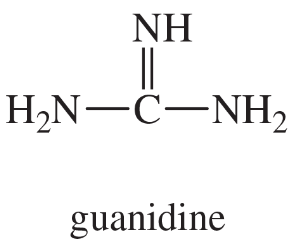
Guanidine (shown) is about as strong a base as hydroxide ion. Explain why guanidine is a much stronger base than most other amines.

Verified step by step guidance
1
Step 1: Recognize that guanidine is a stronger base than most amines due to its unique structure, which allows for resonance stabilization of the conjugate acid. The structure of guanidine includes a central carbon atom bonded to three nitrogen atoms, one of which is double-bonded.
Step 2: Understand that when guanidine acts as a base, it accepts a proton (H⁺) on one of its nitrogen atoms, forming a positively charged conjugate acid. This conjugate acid is stabilized by resonance, as the positive charge can delocalize across the three nitrogen atoms.
Step 3: Compare this resonance stabilization to typical amines. In most amines, the lone pair of electrons on the nitrogen atom is localized, and the conjugate acid does not benefit from resonance stabilization. This makes guanidine a much stronger base than most amines.
Step 4: Note that the delocalization of the positive charge in guanidine's conjugate acid reduces the energy of the system, making the protonated form more stable. This increased stability corresponds to a higher basicity for guanidine.
Step 5: Conclude that the strength of guanidine as a base is primarily due to the resonance stabilization of its conjugate acid, which is not a feature present in most other amines.

Verified video answer for a similar problem:

This video solution was recommended by our tutors as helpful for the problem above.
Video duration:
2m
Was this helpful?

Key Concepts

Here are the essential concepts you must grasp in order to answer the question correctly.

Basicity of Amines

Basicity in organic chemistry refers to the ability of a compound to accept protons (H+ ions). Amines, which contain a nitrogen atom with a lone pair of electrons, can act as bases by donating this lone pair to bond with protons. The strength of an amine as a base is influenced by factors such as steric hindrance and the electron-donating or withdrawing effects of substituents attached to the nitrogen.
Recommended video:
Guided course
07:12
Reductive Amination

Resonance Stabilization

Resonance stabilization occurs when a molecule can be represented by multiple valid Lewis structures, allowing for the delocalization of electrons. In the case of guanidine, resonance allows the positive charge that forms upon protonation to be distributed over multiple atoms, which stabilizes the molecule and enhances its basicity compared to other amines that lack such resonance structures.
Recommended video:
Guided course
03:43
The radical stability trend.

Inductive Effect

The inductive effect refers to the electron-withdrawing or electron-donating influence of substituents on a molecule through sigma bonds. In guanidine, the presence of multiple electronegative atoms can enhance the electron density on the nitrogen atom, making it more capable of accepting protons. This effect contributes to guanidine's strong basicity compared to other amines, which may have less favorable inductive effects.
Recommended video:
Guided course
01:47
Understanding the Inductive Effect.
Related Practice
Textbook Question

Pyrrole undergoes electrophilic aromatic substitution more readily than benzene, and mild reagents and conditions are sufficient. These reactions normally occur at the 2-position rather than the 3-position, as shown in the following example.

b. Explain why pyrrole reacts more readily than benzene, and also why substitution occurs primarily at the 2-position rather than the 3-position.

2788
views
Textbook Question

Basicity depends on availability of an electron pair to bond a proton. Correlate structural effects in these amines with their basicities.

(a) Explain this order:

849
views
Textbook Question

The following spectra for A and B correspond to two structural isomers. The NMR singlet at δ1.16 in spectrum A disappears when the sample is shaken with D2O. The singlet at δ0.6 ppm in the spectrum of B disappears on shaking with D2O. Propose structures for these isomers, and show how your structures correspond to the spectra. Show what cleavage is responsible for the base peak at m/z 44 in the mass spectrum of A and the prominent peak at m/z 58 in the mass spectrum of B.

<IMAGE>

1583
views
Textbook Question

Show why p-nitroaniline is a much weaker base (3 pKb units weaker) than aniline.

1168
views
Textbook Question

Explain why N,N,2,6-tetramethylaniline (shown) is a much stronger base than N,N-dimethylaniline.

977
views
Textbook Question

Pyrrole undergoes electrophilic aromatic substitution more readily than benzene, and mild reagents and conditions are sufficient. These reactions normally occur at the 2-position rather than the 3-position, as shown in the following example.

a. Propose a mechanism for the acetylation of pyrrole just shown. You may begin with pyrrole and the acylium ion, CH3C≡O+. Be careful to draw all the resonance structures of the intermediate.

4010
views