Ch. 9 - Substitution and Elimination Reactions of Alkyl Halides
Bruice - Organic Chemistry 8th Edition
Bruice8th EditionOrganic ChemistryISBN: 9780135213711Not the one you use?Change textbook
Chapter 10, Problem 44

a. Assuming that the two compounds shown below have the same stability, which one would you expect to be more reactive in an SN1 reaction?

b. Draw the products that each would form when the solvent is ethanol.

Verified step by step guidance
1
Step 1: Analyze the structures of the two compounds. Both compounds contain a bromine atom attached to a carbon that is adjacent to a double bond (allylic position). This makes them suitable for SN1 reactions, as the carbocation formed after the departure of bromine can be stabilized by resonance with the double bond.
Step 2: Compare the degree of substitution of the carbocation formed in each case. In the first compound, the carbocation formed after bromine leaves is secondary and allylic. In the second compound, the carbocation formed is tertiary and allylic. Tertiary carbocations are more stable than secondary carbocations due to greater hyperconjugation and inductive effects.
Step 3: Predict the reactivity in an SN1 reaction. Since the second compound forms a more stable carbocation (tertiary allylic), it is expected to be more reactive in an SN1 reaction compared to the first compound.
Step 4: Consider the solvent ethanol. Ethanol is a polar protic solvent, which can stabilize the carbocation intermediate and also act as a nucleophile to attack the carbocation, leading to the formation of an ether product.
Step 5: Draw the products for each compound. For the first compound, the product will be formed by ethanol attacking the secondary allylic carbocation, resulting in an ether. For the second compound, the product will be formed by ethanol attacking the tertiary allylic carbocation, also resulting in an ether. Ensure resonance structures are considered when drawing the intermediates.

Verified video answer for a similar problem:

This video solution was recommended by our tutors as helpful for the problem above.
Video duration:
6m
Was this helpful?

Key Concepts

Here are the essential concepts you must grasp in order to answer the question correctly.

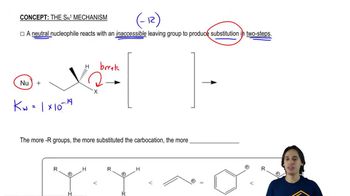
SN1 Reaction Mechanism

The SN1 (Substitution Nucleophilic Unimolecular) reaction mechanism involves two main steps: the formation of a carbocation intermediate and the subsequent nucleophilic attack. The rate-determining step is the formation of the carbocation, which is influenced by the stability of the carbocation formed. More stable carbocations, such as tertiary ones, are more likely to undergo SN1 reactions due to their lower energy and greater likelihood of formation.
Recommended video:
Guided course
10:49
Drawing the SN1 Mechanism

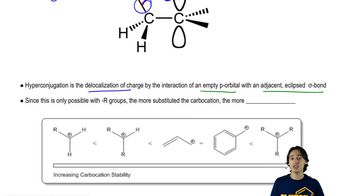
Carbocation Stability

Carbocation stability is a crucial factor in determining the reactivity of compounds in SN1 reactions. Carbocations are stabilized by hyperconjugation and inductive effects from adjacent alkyl groups. Tertiary carbocations are the most stable, followed by secondary and primary, with methyl carbocations being the least stable. The stability of the carbocation directly affects the rate of the SN1 reaction.
Recommended video:
Guided course
05:58
Determining Carbocation Stability

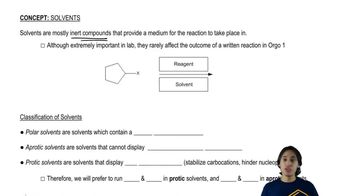
Solvent Effects in SN1 Reactions

The choice of solvent plays a significant role in SN1 reactions, particularly polar protic solvents like ethanol. These solvents can stabilize the carbocation intermediate and the leaving group through solvation, which lowers the activation energy for the reaction. In ethanol, the solvent can also act as a nucleophile, participating in the reaction to form the final product, which is essential for predicting the outcome of the reaction.
Recommended video:
Guided course
02:26
General format of reactions and how to interpret solvents.