
Ch. 7 - Structure and Synthesis of Alkenes; Elimination
Wade - Organic Chemistry 9th Edition
Wade9th EditionOrganic ChemistryISBN: 9780135213728Not the one you use?Change textbook
Chapter 7, Problem 37d

For practice in recognizing mechanisms, classify each reaction according to the type of mechanism you expect:
1. Free-radical chain reaction
2. Reaction involving strong bases and strong nucleophiles
3. Reaction involving strong acids and strong electrophiles.
(d)

Verified step by step guidance
1
Step 1: Understand the types of mechanisms. A free-radical chain reaction involves the formation of radicals, typically initiated by heat or light, and proceeds through propagation and termination steps. Reactions involving strong bases and nucleophiles often follow an SN2 or E2 mechanism, while reactions with strong acids and electrophiles typically follow an SN1 or E1 mechanism.
Step 2: Analyze the given reaction: ethylene BF3—> polyethylene. This reaction involves the polymerization of ethylene to form polyethylene, which is a type of addition polymerization.
Step 3: Recognize that addition polymerization can occur through different mechanisms, such as free-radical, cationic, or anionic polymerization. In this case, BF3 is a Lewis acid, which suggests a cationic polymerization mechanism.
Step 4: In cationic polymerization, the Lewis acid (BF3) acts as an electrophile, initiating the polymerization by forming a carbocation intermediate. This intermediate then reacts with additional ethylene molecules to propagate the chain reaction.
Step 5: Conclude that the mechanism for the given reaction is likely a cationic polymerization, initiated by the Lewis acid BF3, leading to the formation of polyethylene from ethylene.

Verified video answer for a similar problem:

This video solution was recommended by our tutors as helpful for the problem above.
Video duration:
2m
Was this helpful?

Key Concepts

Here are the essential concepts you must grasp in order to answer the question correctly.

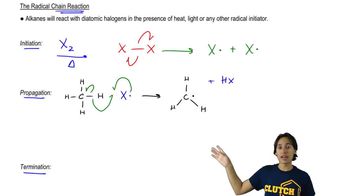
Free-Radical Chain Reaction

A free-radical chain reaction involves three main steps: initiation, propagation, and termination. Initiation generates radicals, often through the homolytic cleavage of a bond. Propagation involves radicals reacting with stable molecules to form new radicals, perpetuating the chain. Termination occurs when radicals combine to form stable products, ending the chain reaction.
Recommended video:
Guided course
12:11
Radical Chain Reaction Mechanism.

Strong Bases and Strong Nucleophiles

Strong bases and strong nucleophiles are species that can donate electrons readily. In organic reactions, strong bases often abstract protons, while strong nucleophiles attack electrophilic centers, forming new bonds. Understanding their role is crucial for predicting reaction pathways, such as substitution or elimination mechanisms.
Recommended video:
Guided course
03:10
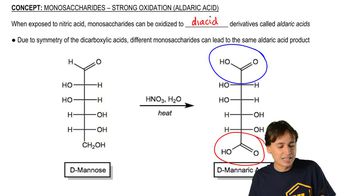
Monosaccharides - Strong Oxidation (Aldaric Acid)

Strong Acids and Strong Electrophiles

Strong acids are proton donors that can activate electrophiles by increasing their positive charge, making them more susceptible to nucleophilic attack. Strong electrophiles are species that accept electrons easily, often forming new bonds with nucleophiles. Recognizing these interactions helps in understanding addition and substitution reactions.
Recommended video:
Guided course
03:10
Monosaccharides - Strong Oxidation (Aldaric Acid)