Ch. 16 - Aromatic Compounds
Wade - Organic Chemistry 9th Edition
Wade9th EditionOrganic ChemistryISBN: 9780135213728Not the one you use?Change textbook
Chapter 16, Problem 19g,h

Explain why each compound is aromatic, antiaromatic, or nonaromatic.
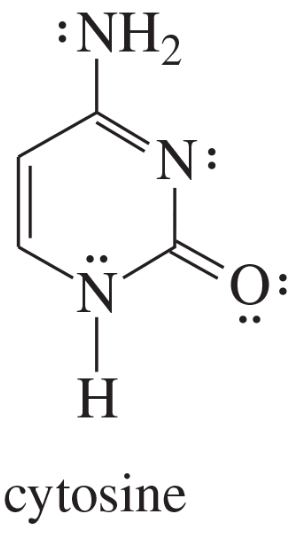
(g)
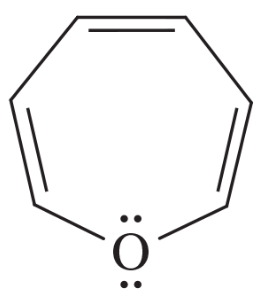
(h)

Verified step by step guidance
1
Step 1: Recall the criteria for aromaticity. A compound is aromatic if it satisfies the following conditions: (a) It is cyclic, (b) It is planar, (c) It has a conjugated π-electron system, and (d) It follows Huckel's rule, which states that the molecule must have (4n + 2) π-electrons, where n is an integer.
Step 2: Analyze compound (g), cytosine. Cytosine is a six-membered ring containing nitrogen and oxygen atoms. The ring is cyclic and planar due to sp2 hybridization of the atoms in the ring. The conjugated π-electron system includes the double bonds and lone pairs on the heteroatoms. Count the π-electrons to determine if it satisfies Huckel's rule.
Step 3: For compound (g), cytosine, consider the lone pairs on the nitrogen and oxygen atoms. Not all lone pairs contribute to aromaticity; only those in conjugation with the π-system are considered. Verify if the total π-electron count is (4n + 2). If it satisfies Huckel's rule, the compound is aromatic; if not, it is nonaromatic or antiaromatic.
Step 4: Analyze compound (h), a six-membered ring with oxygen. The ring is cyclic and planar, and it has alternating double bonds, indicating a conjugated π-electron system. Count the π-electrons, including the lone pair on oxygen, to determine if it satisfies Huckel's rule.
Step 5: For compound (h), verify if the lone pair on oxygen contributes to the conjugated π-system. If the total π-electron count satisfies Huckel's rule, the compound is aromatic. If it does not satisfy Huckel's rule, determine if the compound is antiaromatic (4n π-electrons) or nonaromatic (does not meet the criteria for aromaticity).

Verified video answer for a similar problem:

This video solution was recommended by our tutors as helpful for the problem above.
Video duration:
5m
Was this helpful?

Key Concepts

Here are the essential concepts you must grasp in order to answer the question correctly.

Aromaticity

Aromatic compounds are cyclic, planar molecules with a ring of resonance that follow Hückel's rule, which states they must have 4n + 2 π electrons (where n is a non-negative integer). This delocalization of electrons contributes to their stability and unique chemical properties. Common examples include benzene and its derivatives.
Recommended video:
Guided course
08:19
Intro to Aromaticity

Antiaromaticity

Antiaromatic compounds are also cyclic and planar but contain 4n π electrons, leading to destabilization due to the presence of electron-electron repulsion in the ring. This instability often results in higher reactivity compared to nonaromatic compounds. An example of an antiaromatic compound is cyclobutadiene.
Recommended video:
Guided course
02:58
Determine the aromaticity

Nonaromaticity

Nonaromatic compounds do not meet the criteria for aromaticity or antiaromaticity. They may be acyclic, lack planarity, or have an insufficient number of π electrons. These compounds do not exhibit the special stability associated with aromatic systems and typically behave like aliphatic compounds. An example is cyclohexane.