Ch. 8 - Alkenes I: Properties and Electrophilic Additions
Mullins - Organic Chemistry: A Learner Centered Approach 1st Edition
Mullins1st EditionOrganic Chemistry: A Learner Centered ApproachISBN: 9780137566471Not the one you use?Change textbook
Chapter 7, Problem 26

Which would you expect to be more selective for carbocation formation, the electrophilic addition of HF or HBr to 2-methylbut-2-ene? Explain your answer.
Electrophilic addition of HF and HBr to 2-methylbut-2-ene showing carbocation formation.

Verified step by step guidance
1
Begin by understanding the concept of electrophilic addition to alkenes. In this reaction, the alkene acts as a nucleophile and the hydrogen halide (HX) acts as an electrophile. The reaction proceeds through the formation of a carbocation intermediate.
Consider the stability of carbocations. Carbocations are stabilized by hyperconjugation and the inductive effect of alkyl groups. Tertiary carbocations are more stable than secondary, which are more stable than primary.
Analyze the role of the halide in the electrophilic addition. The halide ion (X⁻) formed after the initial protonation of the alkene can stabilize the carbocation through back-donation of electron density. The ability of the halide to stabilize the carbocation is related to its electronegativity and size.
Compare HF and HBr in terms of their ability to stabilize carbocations. HF is more electronegative than HBr, meaning it holds onto its electrons more tightly and is less likely to donate electron density to stabilize the carbocation. Conversely, HBr, being less electronegative, can better stabilize the carbocation through back-donation.
Conclude that HBr is expected to be more selective for carbocation formation than HF when added to 2-methylbut-2-ene. This is because the bromide ion is better able to stabilize the carbocation intermediate, leading to a more favorable reaction pathway.

Verified video answer for a similar problem:

This video solution was recommended by our tutors as helpful for the problem above.
Video duration:
3m
Was this helpful?

Key Concepts

Here are the essential concepts you must grasp in order to answer the question correctly.

Electrophilic Addition

Electrophilic addition is a reaction where an electrophile reacts with a nucleophile, typically involving alkenes. In this process, the pi bond of the alkene is broken, and new sigma bonds are formed. Understanding this mechanism is crucial for predicting the formation of carbocations during the addition of hydrogen halides like HF and HBr.
Recommended video:
Guided course
09:23
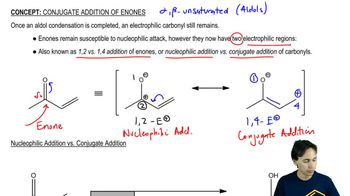
1,2 vs 1,4 Addition

Carbocation Stability

Carbocation stability is influenced by factors such as the number of alkyl groups attached to the positively charged carbon, resonance, and hyperconjugation. More substituted carbocations are generally more stable due to the electron-donating effects of alkyl groups, which help stabilize the positive charge. This concept is essential for predicting the outcome of electrophilic addition reactions.
Recommended video:
Guided course
05:58
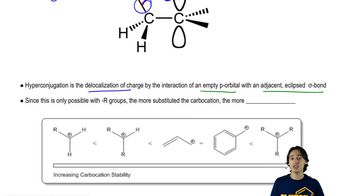
Determining Carbocation Stability

Markovnikov's Rule

Markovnikov's Rule states that in the addition of HX to an unsymmetrical alkene, the hydrogen atom will attach to the carbon with more hydrogen atoms, while the halide will attach to the carbon with fewer hydrogen atoms. This rule helps predict the regioselectivity of the reaction, which is crucial for understanding which carbocation will form during the addition of HF or HBr to 2-methylbut-2-ene.
Recommended video:
Guided course
03:54
The 18 and 16 Electron Rule