
Ch. 7 - Structure and Synthesis of Alkenes; Elimination
Wade - Organic Chemistry 9th Edition
Wade9th EditionOrganic ChemistryISBN: 9780135213728Not the one you use?Change textbook
Chapter 7, Problem 12

Use the data in Table 7-2 to predict the energy difference between 2,3-dimethylbut-1-ene and 2,3-dimethylbut-2-ene. Which of these double-bond isomers is more stable?

Verified step by step guidance
1
Step 1: Locate the molar heats of hydrogenation (ΔH°) for the two compounds in Table 7-2. For 2,3-dimethylbut-1-ene, the value is 116.3 kJ, and for 2,3-dimethylbut-2-ene, the value is 110.4 kJ.
Step 2: Understand the relationship between the molar heat of hydrogenation and stability. A lower molar heat of hydrogenation corresponds to greater stability of the alkene because less energy is released during hydrogenation.
Step 3: Compare the molar heats of hydrogenation for the two compounds. Since 2,3-dimethylbut-2-ene has a lower ΔH° (110.4 kJ) compared to 2,3-dimethylbut-1-ene (116.3 kJ), it is more stable.
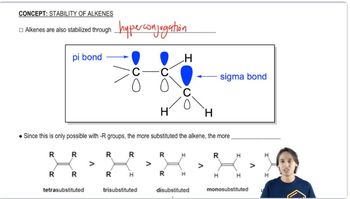
Step 4: Analyze the substitution pattern of the double bond in each compound. 2,3-dimethylbut-2-ene is a tetrasubstituted alkene, while 2,3-dimethylbut-1-ene is a trisubstituted alkene. Tetrasubstituted alkenes are generally more stable due to hyperconjugation and steric effects.
Step 5: Conclude that the energy difference between the two compounds can be calculated by subtracting the molar heat of hydrogenation of 2,3-dimethylbut-2-ene from that of 2,3-dimethylbut-1-ene. This difference reflects the relative stability of the two isomers.

Verified video answer for a similar problem:

This video solution was recommended by our tutors as helpful for the problem above.
Video duration:
5m
Was this helpful?

Key Concepts

Here are the essential concepts you must grasp in order to answer the question correctly.

Stability of Alkenes

The stability of alkenes is influenced by the degree of substitution at the double bond. More substituted alkenes (those with more alkyl groups attached to the carbon atoms of the double bond) are generally more stable due to hyperconjugation and the inductive effect, which help to stabilize the double bond. This concept is crucial for predicting the relative stability of isomers.
Recommended video:
Guided course
04:28
Understanding trends of alkene stability.

Heat of Hydrogenation

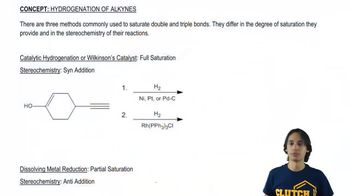
The heat of hydrogenation is a measure of the energy released when an alkene is converted to an alkane through the addition of hydrogen. A lower heat of hydrogenation indicates a more stable alkene, as it requires less energy to break the double bond. This concept allows for the comparison of alkene stability based on their heats of hydrogenation, as shown in the provided table.
Recommended video:
Guided course
00:48
The definition of hydrogenation.

Isomerism in Alkenes

Isomerism in alkenes refers to the existence of compounds with the same molecular formula but different structural arrangements. In the case of 2,3-dimethylbut-1-ene and 2,3-dimethylbut-2-ene, the position of the double bond and the arrangement of substituents lead to different isomers. Understanding isomerism is essential for predicting the properties and stability of these compounds.
Recommended video:
2:09
Alkene Metathesis Concept 1