Ch. 5 - Chemical Reaction Analysis: Thermodynamics and Kinetics
Mullins - Organic Chemistry: A Learner Centered Approach 1st Edition
Mullins1st EditionOrganic Chemistry: A Learner Centered ApproachISBN: 9780137566471Not the one you use?Change textbook
Chapter 4, Problem 15b

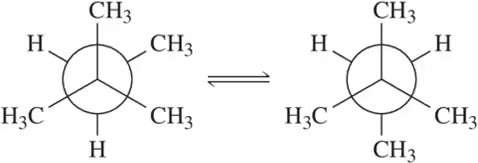
Calculate ∆H° for the following equilibrium processes.
(b) Chemical structure diagram showing an equilibrium process with two molecular representations of a compound.

Verified step by step guidance
1
Identify the equilibrium process and write the balanced chemical equation for the reaction. Ensure that all reactants and products are correctly represented.
Determine the standard enthalpy of formation (∆H°f) for each reactant and product involved in the reaction. These values are typically found in thermodynamic tables.
Apply Hess's Law to calculate the overall enthalpy change (∆H°) for the reaction. Use the formula: ∆H° = Σ(∆H°f of products) - Σ(∆H°f of reactants).
Substitute the standard enthalpy of formation values into the formula. Be sure to multiply each ∆H°f value by the stoichiometric coefficient of the corresponding substance in the balanced equation.
Simplify the expression to find the value of ∆H° for the equilibrium process. Ensure that units are consistent (e.g., kJ/mol).

Verified video answer for a similar problem:

This video solution was recommended by our tutors as helpful for the problem above.
Video duration:
3m
Was this helpful?

Key Concepts

Here are the essential concepts you must grasp in order to answer the question correctly.

Enthalpy Change (∆H°)

Enthalpy change (∆H°) is the heat content change of a system at constant pressure. It indicates whether a reaction is exothermic (releases heat, ∆H° < 0) or endothermic (absorbs heat, ∆H° > 0). Understanding how to calculate ∆H° is crucial for predicting the energy changes associated with chemical reactions and equilibrium processes.
Recommended video:
Guided course
04:38
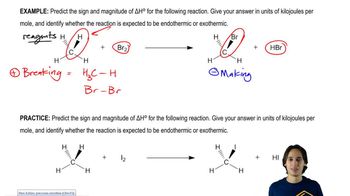
Calculating Enthalpies

Equilibrium Constant (K)

The equilibrium constant (K) quantifies the ratio of the concentrations of products to reactants at equilibrium for a reversible reaction. It is temperature-dependent and provides insight into the position of equilibrium. A larger K value indicates a greater concentration of products, while a smaller K suggests a predominance of reactants, which is essential for calculating ∆H° using the van 't Hoff equation.
Recommended video:
Guided course
02:19
The relationship between equilibrium constant and pKa.

Le Chatelier's Principle

Le Chatelier's Principle states that if a dynamic equilibrium is disturbed by changing the conditions, the system will adjust to counteract the change and restore a new equilibrium. This principle is vital for understanding how changes in concentration, temperature, or pressure affect the position of equilibrium and the associated enthalpy changes in a reaction.
Recommended video:
Guided course
04:12
The Electron Configuration