Ch. 21 - Carboxylic Acid Derivatives
Wade - Organic Chemistry 9th Edition
Wade9th EditionOrganic ChemistryISBN: 9780135213728Not the one you use?Change textbook
Chapter 21, Problem 42a,b,c

Draw structures to correspond with the following common and systematic names:
(a) phenyl formate 
(b) cyclohexyl benzoate 
(c) cyclopentyl phenylacetate

Verified step by step guidance
1
Identify the functional group in each compound name. For esters, the name is derived from the alcohol and carboxylic acid components. The first part of the name corresponds to the alcohol-derived alkyl or aryl group, and the second part corresponds to the acid-derived portion.
For (a) phenyl formate: The 'phenyl' group is a benzene ring (C₆H₅), and 'formate' comes from formic acid (HCOOH). Replace the hydrogen in formic acid with the phenyl group to form the ester structure.
For (b) cyclohexyl benzoate: The 'cyclohexyl' group is a six-membered cycloalkane (C₆H₁₁), and 'benzoate' comes from benzoic acid (C₆H₅COOH). Replace the hydrogen in benzoic acid with the cyclohexyl group to form the ester structure.
For (c) cyclopentyl phenylacetate: The 'cyclopentyl' group is a five-membered cycloalkane (C₅H₉), and 'phenylacetate' comes from phenylacetic acid (C₆H₅CH₂COOH). Replace the hydrogen in phenylacetic acid with the cyclopentyl group to form the ester structure.
Draw the structures for each compound by combining the alcohol-derived group and the acid-derived group, ensuring the ester functional group (-COO-) is correctly formed in each case.

Verified video answer for a similar problem:

This video solution was recommended by our tutors as helpful for the problem above.
Video duration:
4m
Was this helpful?

Key Concepts

Here are the essential concepts you must grasp in order to answer the question correctly.

Functional Groups

Functional groups are specific groups of atoms within molecules that are responsible for the characteristic chemical reactions of those molecules. In organic chemistry, recognizing functional groups such as esters, phenols, and carboxylic acids is essential for drawing structures based on names. For example, phenyl formate contains a phenyl group and an ester functional group derived from formic acid.
Recommended video:
Guided course
02:36
Identifying Functional Groups

Nomenclature Rules

IUPAC nomenclature provides a systematic way to name organic compounds based on their structure. Understanding the rules for naming compounds, including the identification of the longest carbon chain and the correct suffixes for functional groups, is crucial for translating names into chemical structures. For instance, 'benzoate' indicates the presence of a benzoic acid derivative, guiding the structure's construction.
Recommended video:
4:02
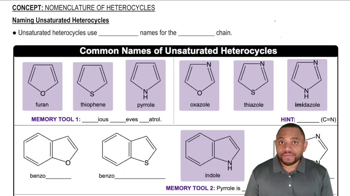
Nomenclature of Heterocycles Concept 2

Structural Representation

Structural representation involves depicting the arrangement of atoms within a molecule, including bonds and functional groups. This can be done through various methods such as Lewis structures, condensed formulas, or skeletal structures. Accurately representing the structures corresponding to names like cyclohexyl benzoate requires an understanding of how to illustrate cyclic and acyclic components effectively.
Recommended video:
Guided course
05:09
Representations of L-Configuration