
Ch. 24 - Benzene II: Reactions Influenced by the Aromatic Ring
Mullins - Organic Chemistry: A Learner Centered Approach 1st Edition
Mullins1st EditionOrganic Chemistry: A Learner Centered ApproachISBN: 9780137566471Not the one you use?Change textbook
Chapter 23, Problem 11a

Though the nitro group is electron-withdrawing by resonance, when in the meta position, it doesn’t communicate by resonance with the phenoxide anion. And yet, the pKₐ value of m-nitrophenol is lowered from 10 (the pKₐ value of unsubstituted phenol) to 8.4. Explain this observation.

Verified step by step guidance
1
Begin by understanding the concept of electron-withdrawing groups and their effect on acidity. The nitro group (NO₂) is a strong electron-withdrawing group due to its ability to stabilize negative charge through resonance and inductive effects.
Consider the position of the nitro group on the phenol ring. In the meta position, the nitro group cannot participate in resonance with the phenoxide anion because the resonance structures require ortho or para positions for effective overlap of p orbitals.
Despite the lack of resonance interaction, the nitro group still exerts an inductive effect. This effect pulls electron density away from the phenol ring, stabilizing the phenoxide anion by reducing electron density on the oxygen atom.
The stabilization of the phenoxide anion by the inductive effect of the nitro group increases the acidity of m-nitrophenol compared to unsubstituted phenol. This is because the phenoxide anion is more stable, making it easier for the phenol to lose a proton.
Conclude by noting that the pKₐ value is a measure of acidity, and the decrease from 10 to 8.4 indicates that m-nitrophenol is more acidic than phenol due to the inductive effect of the nitro group, even without resonance interaction.

Verified video answer for a similar problem:

This video solution was recommended by our tutors as helpful for the problem above.
Video duration:
6m
Was this helpful?

Key Concepts

Here are the essential concepts you must grasp in order to answer the question correctly.

Electron-Withdrawing Groups

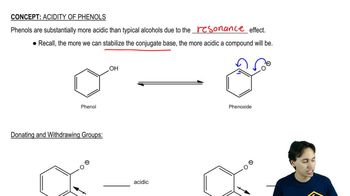
Electron-withdrawing groups (EWGs) are substituents that pull electron density away from other parts of a molecule through resonance or inductive effects. In the case of nitrophenol, the nitro group is a strong EWG, which stabilizes the negative charge on the phenoxide ion, thereby increasing the acidity of the phenol and lowering its pKₐ value.
Recommended video:
Guided course
02:37
Donating vs Withdrawing Groups

Resonance and Inductive Effects

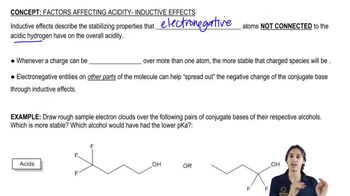
Resonance involves the delocalization of electrons across adjacent atoms, while inductive effects involve the transmission of charge through sigma bonds. Although the nitro group in m-nitrophenol does not participate in resonance with the phenoxide ion, it still exerts an inductive effect, pulling electron density away and stabilizing the ion, which contributes to the lower pKₐ.
Recommended video:
Guided course
01:47
Understanding the Inductive Effect.

Acidity and pKₐ

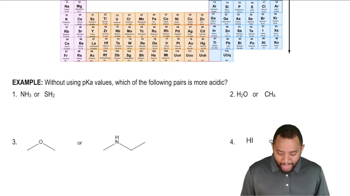
The acidity of a compound is often expressed in terms of its pKₐ value, which is the negative logarithm of its acid dissociation constant (Kₐ). A lower pKₐ indicates a stronger acid. In m-nitrophenol, the presence of the nitro group stabilizes the phenoxide ion, making the phenol more acidic compared to unsubstituted phenol, thus lowering the pKₐ from 10 to 8.4.
Recommended video:
Guided course
02:23
Using factors affecting acidity to rank acids