Ch. 11 - Properties and Synthesis of Alkyl Halides: Radical Reactions
Mullins - Organic Chemistry: A Learner Centered Approach 1st Edition
Mullins1st EditionOrganic Chemistry: A Learner Centered ApproachISBN: 9780137566471Not the one you use?Change textbook
Chapter 10, Problem 50

Identify the two different alkenes that undergo allylic halogenation to prepare the compound shown.
Chemical reaction showing allylic bromination with NBS and heat, forming a brominated alkene from two different alkenes.

Verified step by step guidance
1
Step 1: Understand the concept of allylic halogenation. Allylic halogenation involves the substitution of a hydrogen atom at the allylic position (the carbon atom adjacent to a double bond) with a halogen atom, typically using reagents like N-bromosuccinimide (NBS) in the presence of light or heat.
Step 2: Analyze the structure of the target compound. Identify the location of the halogen atom and the allylic position relative to the double bond in the compound.
Step 3: Determine the possible alkenes that could lead to the target compound through allylic halogenation. Consider the position of the double bond and the allylic carbon that would be halogenated.
Step 4: Draw the structures of the potential alkenes. Ensure that each alkene has a double bond in a position that allows for allylic halogenation to produce the target compound.
Step 5: Verify the structures by considering the mechanism of allylic halogenation. Ensure that the halogenation of each proposed alkene leads to the formation of the target compound, taking into account the stability of the allylic radical intermediates.

Verified video answer for a similar problem:

This video solution was recommended by our tutors as helpful for the problem above.
Video duration:
4m
Was this helpful?

Key Concepts

Here are the essential concepts you must grasp in order to answer the question correctly.

Allylic Halogenation

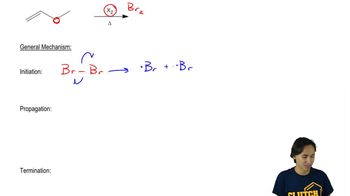
Allylic halogenation is a reaction where a halogen is introduced at the allylic position of an alkene, which is the carbon atom adjacent to the double bond. This reaction typically involves the use of N-bromosuccinimide (NBS) in the presence of light or heat, facilitating the formation of a radical intermediate that leads to the substitution of a hydrogen atom with a halogen.
Recommended video:
Guided course
06:15
The general mechanism of Allylic Halogenation.

Alkene Structure

Alkenes are hydrocarbons containing at least one carbon-carbon double bond, characterized by the general formula CnH2n. The structure of an alkene influences its reactivity and the position of the double bond determines the possible sites for allylic substitution. Understanding the structure is crucial for identifying potential alkenes that can undergo allylic halogenation to form a specific compound.
Recommended video:
1:59
Alkene Metathesis Concept 5

Radical Mechanism

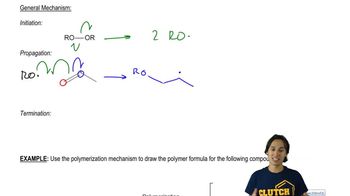
Radical mechanisms involve species with unpaired electrons, which are highly reactive. In allylic halogenation, radicals are generated by the homolytic cleavage of bonds, often initiated by light or heat. These radicals facilitate the substitution process by abstracting hydrogen atoms from the allylic position, allowing halogens to attach and form the desired product.
Recommended video:
Guided course
03:28
The mechanism of Radical Polymerization.