Ch. 13 - Alcohols, Ethers and Related Compounds: Substitution and Elimination
Mullins - Organic Chemistry: A Learner Centered Approach 1st Edition
Mullins1st EditionOrganic Chemistry: A Learner Centered ApproachISBN: 9780137566471Not the one you use?Change textbook
Chapter 12, Problem 44b

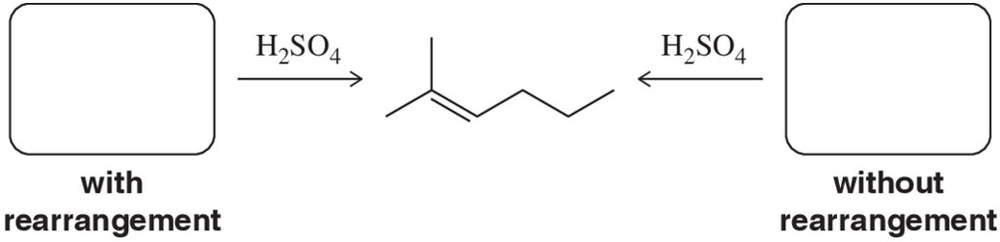
Identify two different alcohols that can be dehydrated (one without rearrangement) to form the alkene shown.
Diagram illustrating dehydration reactions of alcohols to form an alkene, highlighting rearrangement options.

Verified step by step guidance
1
Analyze the given alkene structure and identify the possible positions where the double bond is located. This will help determine the potential alcohol precursors.
Recall that alcohol dehydration involves the elimination of a water molecule, typically under acidic conditions, to form an alkene. The hydroxyl group (-OH) is removed along with a hydrogen atom from an adjacent carbon.
For the first alcohol (without rearrangement), identify a structure where the hydroxyl group is directly attached to one of the carbons involved in the double bond. Ensure that no carbocation rearrangement is necessary during the dehydration process.
For the second alcohol (with potential rearrangement), consider a structure where the hydroxyl group is attached to a carbon that, upon dehydration, could lead to a carbocation intermediate. This intermediate may rearrange to form a more stable carbocation before the double bond is formed.
Draw the structures of the two alcohols and verify that each can undergo dehydration to yield the given alkene. Ensure that the reaction mechanism aligns with the expected pathway (E1 or E2) for each case.

Verified video answer for a similar problem:

This video solution was recommended by our tutors as helpful for the problem above.
Video duration:
2m
Was this helpful?

Key Concepts

Here are the essential concepts you must grasp in order to answer the question correctly.

Dehydration of Alcohols

Dehydration of alcohols is a chemical reaction where an alcohol loses a water molecule, resulting in the formation of an alkene. This process typically requires an acid catalyst and can occur through either an E1 or E2 mechanism, depending on the structure of the alcohol. Understanding this reaction is crucial for identifying which alcohols can yield a specific alkene.
Recommended video:
Guided course
01:23
General Reaction of Dehydration with POCl3

Rearrangement in Dehydration

Rearrangement refers to the structural change that can occur during the dehydration of alcohols, particularly in E1 mechanisms. This can lead to the formation of more stable carbocations, resulting in different alkene products. Recognizing when rearrangement occurs helps in selecting alcohols that will dehydrate without altering the desired product structure.
Recommended video:
Guided course
06:08
Definition of Claisen Rearrangement

Types of Alcohols

Alcohols can be classified as primary, secondary, or tertiary based on the carbon atom to which the hydroxyl group (-OH) is attached. This classification affects their reactivity in dehydration reactions; for instance, tertiary alcohols typically dehydrate more readily than primary alcohols. Identifying the type of alcohol is essential for predicting the dehydration outcome and ensuring the correct alkene is formed.
Recommended video:
Guided course
01:01
How to name alcohols