Ch. 11 - Organometallic Compounds
Bruice - Organic Chemistry 8th Edition
Bruice8th EditionOrganic ChemistryISBN: 9780135213711Not the one you use?Change textbook
Chapter 12, Problem 30

Identify A through H
Chemical reaction diagram showing steps labeled A through H for synthesizing organic compounds.

Verified step by step guidance
1
Step 1: Analyze the starting material, which is 1-bromopropane. The bromine atom is a good leaving group, making this molecule suitable for substitution or elimination reactions.
Step 2: Identify the first reaction (1.A and 2.B). The reagents A and B likely involve a nucleophile and a base, respectively. A substitution reaction (SN2 mechanism) could occur, replacing the bromine atom with a nucleophile to form compound C.
Step 3: Examine compound C, which appears to be propanol (an alcohol). The second reaction (1.D and 2.E) likely involves oxidation or substitution. If oxidation occurs, the alcohol group could be converted into a carbonyl group, forming an aldehyde or ketone.
Step 4: Analyze compound D, which is a longer-chain alcohol. The third reaction (1.F, 2.G, and 3.H) likely involves ether formation. This could be achieved through Williamson ether synthesis, where the alcohol reacts with an alkyl halide in the presence of a base.
Step 5: The final product is an ether, indicating that the alcohol group in compound D has been converted into an ether functional group. The reaction sequence involves substitution and elimination steps to achieve the transformation.

Verified video answer for a similar problem:

This video solution was recommended by our tutors as helpful for the problem above.
Video duration:
7m
Was this helpful?

Key Concepts

Here are the essential concepts you must grasp in order to answer the question correctly.

Nucleophilic Substitution

Nucleophilic substitution is a fundamental reaction in organic chemistry where a nucleophile attacks an electrophile, resulting in the replacement of a leaving group. This process is crucial for understanding how compounds A through H are formed in the reaction sequence. The mechanism can follow either an SN1 or SN2 pathway, depending on the structure of the substrate and the conditions of the reaction.
Recommended video:
Guided course
01:47
Nucleophiles and Electrophiles can react in Substitution Reactions.

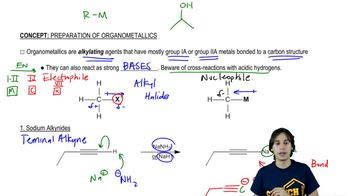
Organometallic Reagents

Organometallic reagents, such as Grignard reagents, are compounds containing a carbon-metal bond, typically involving magnesium or lithium. These reagents are highly reactive and serve as nucleophiles in various organic reactions, including the formation of alcohols and other functional groups. Understanding their reactivity is essential for predicting the outcomes of the transformations depicted in the reaction diagram.
Recommended video:
Guided course
02:50
Ruining Organometallics

Functional Group Transformations

Functional group transformations involve the conversion of one functional group into another through chemical reactions. In the context of the provided reaction scheme, recognizing how different functional groups (like alcohols, ethers, and halides) are interconverted is vital for identifying compounds A through H. Mastery of these transformations allows chemists to synthesize complex molecules efficiently.
Recommended video:
Guided course
02:36
Identifying Functional Groups