Ch.1 - Structure and Bonding
Wade - Organic Chemistry 9th Edition
Wade9th EditionOrganic ChemistryISBN: 9780135213728Not the one you use?Change textbook
Chapter 1, Problem 16b

The electrostatic potential maps for ammonia and water are shown here. The structure of ammonia is shown within its EPM. Note how the lone pair creates a region of high electron potential (red), and the hydrogens are in regions of low electron potential (blue). Show how your three-dimensional structure of water corresponds with its EPM.
Electrostatic potential maps of ammonia and water, showing regions of high and low electron potential.

Verified step by step guidance
1
Examine the electrostatic potential map (EPM) of water (H₂O). Notice the color gradient, which indicates the distribution of electron density. The red region represents areas of high electron density, while the blue region indicates areas of low electron density.
Identify the oxygen atom in the water molecule. In the EPM, the oxygen atom is typically located in the red region, indicating a high electron density due to its lone pairs.
Observe the hydrogen atoms in the water molecule. These are usually found in the blue regions of the EPM, signifying lower electron density compared to the oxygen atom.
Understand the three-dimensional structure of water. Water has a bent shape with an angle of approximately 104.5 degrees between the hydrogen-oxygen-hydrogen atoms. This shape is due to the two lone pairs on the oxygen atom, which repel the hydrogen atoms.
Relate the EPM to the three-dimensional structure. The bent shape of water causes the lone pairs to create a region of high electron potential (red) around the oxygen, while the hydrogen atoms are in regions of low electron potential (blue), consistent with the EPM colors.

Verified video answer for a similar problem:

This video solution was recommended by our tutors as helpful for the problem above.
Video duration:
2m
Was this helpful?

Key Concepts

Here are the essential concepts you must grasp in order to answer the question correctly.

Electrostatic Potential Maps (EPM)

Electrostatic potential maps (EPM) visually represent the charge distribution within a molecule. Regions of high electron density, often associated with lone pairs or electronegative atoms, appear red, indicating negative potential. Conversely, areas with low electron density, typically around hydrogen atoms, appear blue, indicating positive potential. These maps help in understanding molecular polarity and reactivity.
Recommended video:
Guided course
04:28
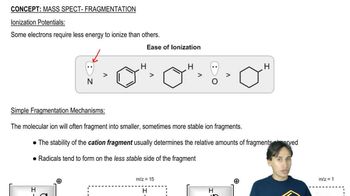
Ionization Potentials

Molecular Geometry

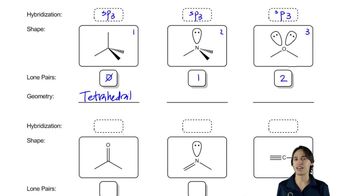
Molecular geometry refers to the three-dimensional arrangement of atoms within a molecule. For ammonia (NH3), the geometry is trigonal pyramidal due to the lone pair on nitrogen, while water (H2O) has a bent shape due to the two lone pairs on oxygen. This geometry affects the molecule's polarity and the distribution of electron density, as seen in their EPMs.
Recommended video:
Guided course
07:44
Molecular Geometry Explained.

Polarity and Dipole Moments

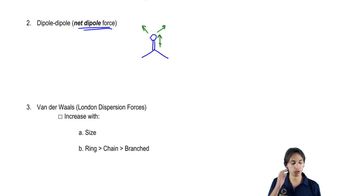
Polarity in molecules arises from differences in electronegativity between bonded atoms, leading to dipole moments. In water, the bent shape and the electronegativity difference between oxygen and hydrogen create a significant dipole moment, making it highly polar. Ammonia also has a dipole moment due to its trigonal pyramidal shape and the lone pair on nitrogen, contributing to its polarity.
Recommended video:
Guided course
01:46
How dipole-dipole forces work.