
Textbook Question
Show how Wittig reactions might be used to synthesize the following compounds. In each case, start with an alkyl halide and a ketone or an aldehyde.
(a) Ph–CH=C(CH3)2
(b) Ph–C(CH3)=CH2
1493
views

 Verified step by step guidance
 01:52
01:52
 06:00
06:00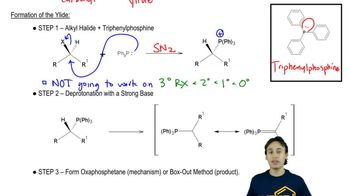 15:39
15:39Show how Wittig reactions might be used to synthesize the following compounds. In each case, start with an alkyl halide and a ketone or an aldehyde.
(a) Ph–CH=C(CH3)2
(b) Ph–C(CH3)=CH2
Like other strong nucleophiles, triphenylphosphine attacks and opens epoxides. The initial product (a betaine) quickly cyclizes to an oxaphosphetane that collapses to an alkene and triphenylphosphine oxide.
(b) Show how this sequence might be used to convert cis-cyclooctene to trans-cyclooctene.
Predict the major products of the following reactions.
(a)
Like other strong nucleophiles, triphenylphosphine attacks and opens epoxides. The initial product (a betaine) quickly cyclizes to an oxaphosphetane that collapses to an alkene and triphenylphosphine oxide.
(a) Show each step in the reaction of trans-2,3-epoxybutane with triphenylphosphine to give but-2-ene. What is the stereochemistry of the double bond in the product?
Show how Wittig reactions might be used to synthesize the following compounds. In each case, start with an alkyl halide and a ketone or an aldehyde.
(c) Ph–CH=CH–CH=CH–Ph
(d)
Write the sequence of steps required for the conversion of benzene into benzenediazonium chloride.