
Ch. 15 - Structural Identification II: Nuclear Magnetic Resonance Spectroscopy
Mullins - Organic Chemistry: A Learner Centered Approach 1st Edition
Mullins1st EditionOrganic Chemistry: A Learner Centered ApproachISBN: 9780137566471Not the one you use?Change textbook
Chapter 14, Problem 33c

Being able to recognize patterns of integration and multiplicity for common functional groups makes structure identification more efficient. Draw the pattern of integration and multiplicity you'd expect to see for each common alkyl group.
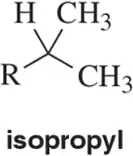
(c) Chemical structure of isopropyl group with central carbon bonded to hydrogen, two methyl groups, and an R group.

Verified step by step guidance
1
Identify the structure of the isopropyl group, which is (CH₃)₂CH−. It consists of two methyl groups (CH₃) and one methine group (CH).
Consider the NMR chemical environment: The two methyl groups are equivalent and will produce a single signal. The methine group is in a different environment and will produce another signal.
Determine the integration pattern: The integration ratio reflects the number of protons. The two methyl groups contribute 6 protons, and the methine group contributes 1 proton. Thus, the integration ratio is 6:1.
Analyze the multiplicity: The methine proton is adjacent to 6 equivalent protons (from the two methyl groups), so it will appear as a septet due to the n+1 rule (where n is the number of neighboring protons).
The methyl protons are adjacent to 1 methine proton, so they will appear as a doublet. Therefore, the expected NMR pattern for an isopropyl group is a doublet for the methyl protons and a septet for the methine proton.

Verified video answer for a similar problem:

This video solution was recommended by our tutors as helpful for the problem above.
Was this helpful?

Key Concepts

Here are the essential concepts you must grasp in order to answer the question correctly.

NMR Spectroscopy

Nuclear Magnetic Resonance (NMR) spectroscopy is a technique used to determine the structure of organic compounds by analyzing the magnetic properties of atomic nuclei. It provides information about the number of hydrogen atoms (integration) and their environment (multiplicity), which helps in identifying functional groups and structural features.
Recommended video:
Guided course
10:06
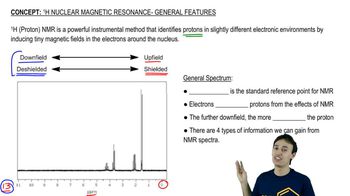
General NMR Features

Integration in NMR

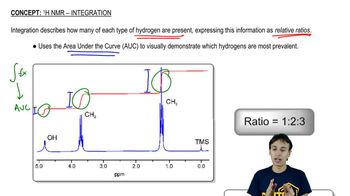
Integration in NMR refers to the area under the peaks in the spectrum, which is proportional to the number of hydrogen atoms contributing to that signal. For isopropyl groups, integration helps determine the relative number of hydrogens in different environments, typically showing a ratio that reflects the CH and CH3 groups present.
Recommended video:
Guided course
06:46
1H NMR Integration

Multiplicity in NMR

Multiplicity in NMR describes the splitting pattern of peaks, which occurs due to spin-spin coupling between neighboring hydrogen atoms. In isopropyl groups, the CH hydrogen is typically split into a doublet by the adjacent CH3 groups, while the CH3 hydrogens appear as a septet due to coupling with the CH hydrogen, indicating the connectivity and environment of these atoms.
Recommended video:
Guided course
10:06
General NMR Features