Ch. 23 - Carbohydrates and Nucleic Acids
Wade - Organic Chemistry 9th Edition
Wade9th EditionOrganic ChemistryISBN: 9780135213728Not the one you use?Change textbook
Chapter 23, Problem 38

Does lactose mutarotate? Is it a reducing sugar? Explain. Draw the two anomeric forms of lactose

Verified step by step guidance
1
Lactose is a disaccharide composed of glucose and galactose linked by a β-1,4-glycosidic bond. To determine if it mutarotates, recall that mutarotation occurs when a sugar has a free anomeric carbon that can interconvert between α and β forms in solution.
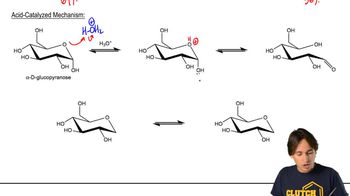
Examine the structure of lactose: The glucose unit in lactose has a free anomeric carbon (not involved in the glycosidic bond). This allows the glucose unit to undergo mutarotation, interconverting between its α and β anomers in solution. Therefore, lactose does mutarotate.
To determine if lactose is a reducing sugar, check if it has a free aldehyde group or a free anomeric carbon that can be oxidized. Since the glucose unit in lactose has a free anomeric carbon, lactose is a reducing sugar.
To draw the two anomeric forms of lactose, represent the disaccharide with the galactose unit linked to the glucose unit via a β-1,4-glycosidic bond. For the glucose unit, draw one structure with the hydroxyl group on the anomeric carbon pointing down (α-anomer) and another with the hydroxyl group pointing up (β-anomer).
Summarize: Lactose mutarotates because it has a free anomeric carbon on the glucose unit, and it is a reducing sugar for the same reason. The two anomeric forms of lactose differ in the orientation of the hydroxyl group on the anomeric carbon of the glucose unit.

Verified video answer for a similar problem:

This video solution was recommended by our tutors as helpful for the problem above.
Video duration:
8m
Was this helpful?

Key Concepts

Here are the essential concepts you must grasp in order to answer the question correctly.

Mutarotation

Mutarotation is the change in optical rotation that occurs when an anomeric carbon in a sugar ring opens and closes, interconverting between its alpha and beta forms. This process is significant for sugars like lactose, as it affects their reactivity and interaction with other molecules. The extent of mutarotation can be measured using polarimetry, providing insights into the sugar's structure and behavior in solution.
Recommended video:

Reducing Sugars

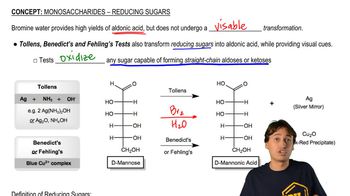
A reducing sugar is a carbohydrate that can donate electrons to another molecule, typically due to the presence of a free aldehyde or ketone group. Lactose, which consists of glucose and galactose, is classified as a reducing sugar because it has a free anomeric carbon that can participate in redox reactions. This property is important in biochemical processes and can be tested using Benedict's or Fehling's solutions.
Recommended video:
Guided course
08:42
Reducing Sugars

Anomeric Forms

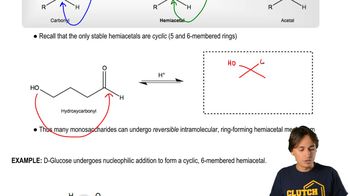
Anomeric forms refer to the two different configurations (alpha and beta) of a sugar at its anomeric carbon, which is the carbon derived from the carbonyl group during cyclization. In lactose, the anomeric carbon is part of the glycosidic bond between glucose and galactose, influencing its stability and reactivity. Drawing these forms helps visualize the structural differences and their implications for the sugar's properties.
Recommended video:
Guided course
06:23
Monosaccharides - Forming Cyclic Hemiacetals
Related Practice
Textbook Question

Draw the structures of the individual mutarotating α and β anomers of maltose.

927
views

Textbook Question

Give an equation to show the reduction of Tollens reagent by maltose.

1003
views
Textbook Question

Trehalose is a nonreducing disaccharide (C12H22O11) isolated from the poisonous mushroom Amanita muscaria. Treatment with an α-glucosidase converts trehalose to two molecules of glucose, but no reaction occurs when trehalose is treated with a β-glucosidase. When trehalose is methylated by dimethyl sulfate in mild base and then hydrolyzed, the only product is 2,3,4,6-tetra-O-methylglucose. Propose a complete structure and systematic name for trehalose.

670
views
Textbook Question

Raffinose is a trisaccharide (C18H32O16) isolated from cottonseed meal. Raffinose does not reduce Tollens reagent, and it does not mutarotate. Complete hydrolysis of raffinose gives D-glucose, D-fructose, and D-galactose. When raffinose is treated with invertase, the products are D-fructose and a reducing disaccharide called melibiose. Raffinose is unaffected by treatment with a β-galactosidase, but an α-galactosidase hydrolyzes it to D-galactose and sucrose. When raffinose is treated with dimethyl sulfate and base followed by hydrolysis, the products are 2,3,4-tri-O-methylglucose, 1,3,4,6-tetra-O-methylfructose, and 2,3,4,6-tetra-O-methylgalactose. Determine the complete structures of raffinose and melibiose, and give a systematic name for melibiose.

1467
views
Textbook Question

Is gentiobiose a reducing sugar? Does it mutarotate? Explain your reasoning

1481
views
Textbook Question

In 1891, Emil Fischer determined the structures of glucose and the seven other D-aldohexoses using only simple chemical reactions and clever reasoning about stereochemistry and symmetry. He received the Nobel Prize for this work in 1902. Fischer had determined that D-glucose is an aldohexose, and he used Ruff degradations to degrade it to (+)-glyceraldehyde. Therefore, the eight D-aldohexose structures shown in Figure 23-3 are the possible structures for glucose.

Pretend that no names are shown in Figure 23-3 except for glyceraldehyde, and use the following results to prove which of these structures represent glucose, mannose, arabinose, and erythrose.

(b) Upon Ruff degradation, arabinose gives the aldotetrose erythrose. Nitric acid oxidation of erythrose gives an optically inactive aldaric acid, meso-tartaric acid. What is the structure of erythrose?

820
views