Ch. 18 - Ketones and Aldehydes
Wade - Organic Chemistry 9th Edition
Wade9th EditionOrganic ChemistryISBN: 9780135213728Not the one you use?Change textbook
Chapter 18, Problem 54e

Predict the products formed when cyclohexanecarbaldehyde reacts with the following reagents.
(e) propane-1,3-diol, H+

Verified step by step guidance
1
Identify the functional group in cyclohexanecarbaldehyde. The molecule contains an aldehyde group (-CHO) attached to a cyclohexane ring.
Understand the reaction type. When an aldehyde reacts with a diol (such as propane-1,3-diol) in the presence of an acid catalyst (H⁺), it undergoes acetal formation. This reaction protects the aldehyde group by converting it into a cyclic acetal.
Write the mechanism of the reaction. The aldehyde group reacts with one hydroxyl group of propane-1,3-diol to form a hemiacetal intermediate. This step involves nucleophilic attack by the hydroxyl group on the carbonyl carbon of the aldehyde, followed by proton transfer.
In the next step, the hemiacetal intermediate reacts with the second hydroxyl group of propane-1,3-diol. This step involves the elimination of water and the formation of a cyclic acetal, which is a stable, protected form of the aldehyde.
Draw the final product. The product will be a six-membered cyclic acetal formed by the reaction of the aldehyde group of cyclohexanecarbaldehyde with propane-1,3-diol. Ensure the stereochemistry and connectivity are correct in the structure.

Verified video answer for a similar problem:

This video solution was recommended by our tutors as helpful for the problem above.
Video duration:
3m
Was this helpful?

Key Concepts

Here are the essential concepts you must grasp in order to answer the question correctly.

Aldol Reaction

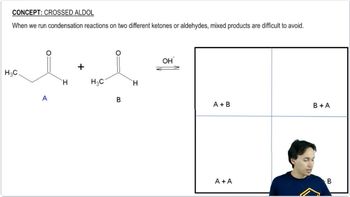
The aldol reaction is a fundamental organic reaction where an enolate ion reacts with a carbonyl compound to form a β-hydroxy aldehyde or ketone. In this case, cyclohexanecarbaldehyde can undergo an aldol condensation with propane-1,3-diol, leading to the formation of a new carbon-carbon bond and a more complex product.
Recommended video:
Guided course
09:51
Crossed Aldol

Acid-Catalyzed Reactions

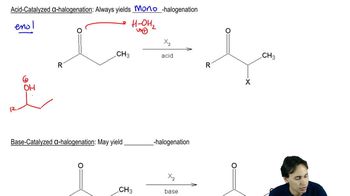
Acid-catalyzed reactions involve the use of an acid to increase the rate of a chemical reaction. In the presence of H+, the carbonyl group of cyclohexanecarbaldehyde becomes more electrophilic, facilitating the nucleophilic attack by the hydroxyl group of propane-1,3-diol, which is essential for forming the desired product.
Recommended video:
Guided course
03:09
Acid Catalyzed

Stereochemistry

Stereochemistry is the study of the spatial arrangement of atoms in molecules and how this affects their chemical behavior. When cyclohexanecarbaldehyde reacts with propane-1,3-diol, the stereochemical outcomes of the reaction can lead to different isomers, which are important to consider when predicting the final products.
Recommended video:
1:38
Polymer Stereochemistry Concept 1