Ch. 21 - Amino Acids, Peptides, and Proteins
Bruice - Organic Chemistry 8th Edition
Bruice8th EditionOrganic ChemistryISBN: 9780135213711Not the one you use?Change textbook
Chapter 22, Problem 39

A decapeptide undergoes partial hydrolysis to give peptides whose amino acid compositions are shown. Reaction of the intact decapeptide with Edman's reagent releases PTH-Gly. What is the sequence of the decapeptide?
1. Ala, Trp
2. Val, Pro, Asp
3. Pro, Val
4. Ala, Glu
5. Trp, Ala, Arg
6. Arg, Gly
7. Glu, Ala, Leu
8. Met, Pro, Leu, Glu

Verified step by step guidance
1
Step 1: Understand the problem. The decapeptide undergoes partial hydrolysis, breaking it into smaller peptide fragments. The amino acid compositions of these fragments are provided. Additionally, Edman degradation releases PTH-Gly, indicating that Glycine is the N-terminal amino acid of the intact decapeptide.
Step 2: Analyze the fragments. Each fragment represents a portion of the decapeptide. The goal is to determine how these fragments fit together to reconstruct the full sequence. Start by identifying overlaps in amino acid compositions between fragments.
Step 3: Use the information from Edman degradation. Since Glycine is the N-terminal amino acid, identify a fragment that starts with Glycine. Fragment 6 (Arg, Gly) is a candidate, suggesting that the sequence begins with Gly-Arg.
Step 4: Look for overlaps between fragments to build the sequence. For example, Fragment 6 (Arg, Gly) overlaps with Fragment 5 (Trp, Ala, Arg) because Arg is common. This suggests the sequence Gly-Arg-Trp-Ala. Continue this process, ensuring that each fragment fits logically with the next.
Step 5: Verify the sequence. Ensure that all fragments are accounted for and that the final sequence contains all 10 amino acids. The sequence should also match the information provided by Edman degradation and the amino acid compositions of the fragments.

Verified video answer for a similar problem:

This video solution was recommended by our tutors as helpful for the problem above.
Video duration:
5m
Was this helpful?

Key Concepts

Here are the essential concepts you must grasp in order to answer the question correctly.

Peptide Structure

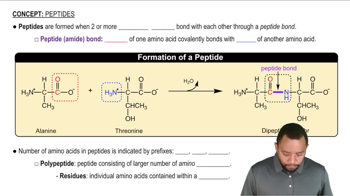
Peptides are short chains of amino acids linked by peptide bonds. The sequence of amino acids in a peptide determines its structure and function. Understanding the primary structure, which is the linear sequence of amino acids, is crucial for deducing the overall sequence of the decapeptide in the question.
Recommended video:
3:07
Peptides Concept 1

Edman's Degradation

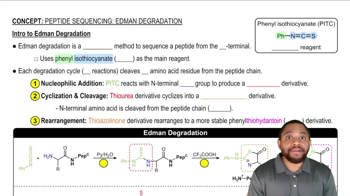
Edman's degradation is a method used to determine the amino acid sequence of a peptide. In this process, Edman's reagent reacts with the amino terminal of the peptide, releasing a phenylthiohydantoin (PTH) derivative of the first amino acid. The information from the released PTH-Gly indicates that glycine is the first amino acid in the sequence, which is essential for solving the question.
Recommended video:
3:10
Peptide Sequencing: Edman Degradation Concept 1

Partial Hydrolysis

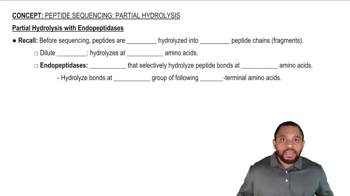
Partial hydrolysis of a peptide involves breaking some peptide bonds, resulting in smaller peptides. The amino acid compositions provided in the question are the products of this hydrolysis. Analyzing these compositions helps in reconstructing the original decapeptide sequence by identifying which combinations of smaller peptides can yield the intact sequence.
Recommended video:
1:19
Peptide Sequencing: Partial Hydrolysis Concept 1