For each molecular formula, represent all constitutional isomers using line-angle drawings. (b) C3H8
Verified step by step guidance
1
Understand the problem: The molecular formula C₃H₈ represents propane, which is an alkane. Constitutional isomers are compounds with the same molecular formula but different connectivity of atoms. For alkanes, we need to consider all possible arrangements of carbon atoms and their hydrogen attachments.
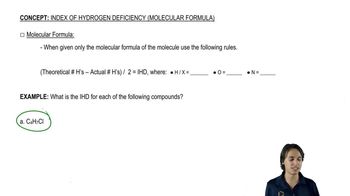
Determine the degree of unsaturation: Use the formula (2C + 2 - H)/2 to calculate the degree of unsaturation. For C₃H₈, the degree of unsaturation is 0, meaning the molecule is fully saturated (no double bonds, triple bonds, or rings).
Start with the longest carbon chain: Draw a straight chain of three carbon atoms (propane) and attach the appropriate number of hydrogens to each carbon to satisfy the octet rule. This is the first possible structure.
Check for branching: Since there are only three carbon atoms, there is no possibility of branching. All carbons must be connected in a single chain, and no other constitutional isomers are possible for C₃H₈.
Verify the structures: Confirm that all valencies are satisfied (each carbon has four bonds) and that the molecular formula matches C₃H₈. In this case, propane is the only constitutional isomer for this molecular formula.
Verified video answer for a similar problem:
This video solution was recommended by our tutors as helpful for the problem above
Play a video:
0 Comments
Key Concepts
Here are the essential concepts you must grasp in order to answer the question correctly.
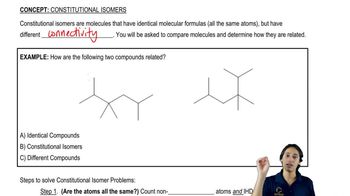
Constitutional Isomers
Constitutional isomers are compounds that have the same molecular formula but differ in the connectivity of their atoms. This means that the arrangement of atoms in the molecule varies, leading to different structural forms. Understanding constitutional isomers is crucial for recognizing how variations in structure can affect the properties and reactivity of organic compounds.
Line-angle drawings, also known as skeletal structures, are a shorthand way of representing organic molecules. In these drawings, vertices represent carbon atoms, and lines represent bonds between them. Hydrogen atoms attached to carbons are usually omitted for simplicity. This method allows chemists to visualize complex structures quickly and is essential for illustrating isomers effectively.
A molecular formula indicates the number and types of atoms in a molecule, represented by chemical symbols and subscripts. For example, C₃H₈ indicates three carbon atoms and eight hydrogen atoms. Understanding molecular formulas is fundamental in organic chemistry, as they provide the basis for identifying possible isomers and their structural variations.