Ch. 25 - Amines: Structure, Reactions, and Synthesis
Mullins - Organic Chemistry: A Learner Centered Approach 1st Edition
Mullins1st EditionOrganic Chemistry: A Learner Centered ApproachISBN: 9780137566471Not the one you use?Change textbook
Chapter 24, Problem 28b

Given the starting reactant, suggest a method for synthesizing the amine on the right.
(b) Chemical reaction diagram showing transformation of an amine to a heterocyclic compound with two nitrogen atoms.

Verified step by step guidance
1
Identify the starting material as a secondary amine with isopropyl groups attached to the nitrogen.
Recognize the target molecule as a pyrazole derivative, which suggests the need for a cyclization reaction involving the nitrogen atom.
Consider the formation of the pyrazole ring, which typically involves the reaction of a 1,3-dicarbonyl compound with hydrazine or a hydrazine derivative.
Propose the use of a 1,3-diketone or a β-keto ester as a starting material to react with the secondary amine to form the pyrazole ring.
Suggest a cyclization step where the secondary amine reacts with the diketone or keto ester to form the pyrazole ring, possibly under acidic or basic conditions to facilitate the reaction.

Verified video answer for a similar problem:

This video solution was recommended by our tutors as helpful for the problem above.
Video duration:
1m
Was this helpful?

Key Concepts

Here are the essential concepts you must grasp in order to answer the question correctly.

Amine Synthesis

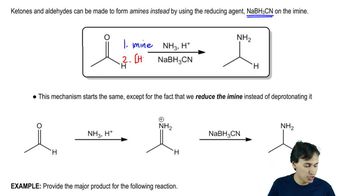
Amine synthesis involves various chemical reactions to produce amines, which are organic compounds containing nitrogen. Common methods include reductive amination, where a carbonyl compound reacts with an amine in the presence of a reducing agent, and nucleophilic substitution, where a leaving group is replaced by an amine. Understanding the structure of the target amine and the reactivity of the starting materials is crucial for selecting the appropriate synthesis route.
Recommended video:
Guided course
07:12
Reductive Amination

Functional Group Transformation

Functional group transformation refers to the process of converting one functional group into another through chemical reactions. In the context of amine synthesis, this may involve converting a carbonyl group (like an aldehyde or ketone) into an amine. Recognizing how different functional groups can be interconverted is essential for designing a synthetic pathway that leads to the desired amine product.
Recommended video:
Guided course
02:36
Identifying Functional Groups

Reagents and Conditions

The choice of reagents and reaction conditions is critical in organic synthesis, as they influence the reaction's efficiency and selectivity. For amine synthesis, common reagents include reducing agents like sodium borohydride or lithium aluminum hydride, and conditions such as temperature and solvent can significantly affect the reaction outcome. A thorough understanding of these factors helps in optimizing the synthesis process to achieve the desired amine.
Recommended video: