Ch. 16 - Reactions of Aldehydes and Ketones • More Reactions of Carboxylic Acid Derivatives
Bruice - Organic Chemistry 8th Edition
Bruice8th EditionOrganic ChemistryISBN: 9780135213711Not the one you use?Change textbook
Chapter 17, Problem 13b

Explain why ethyne should be alkylated before, rather than after, nucleophilic addition.

Verified step by step guidance
1
Ethyne (C₂H₂) is a terminal alkyne, meaning it has a hydrogen atom attached to the sp-hybridized carbon. This hydrogen is relatively acidic due to the high s-character of the sp orbital, making it easier to deprotonate using a strong base like sodium amide (NaNH₂). This step generates a nucleophilic acetylide ion (C≡C⁻), which is highly reactive and can participate in alkylation reactions.
Alkylation involves the reaction of the acetylide ion with an alkyl halide (R-X) to form a new carbon-carbon bond. This reaction is an SN2 mechanism, which requires a strong nucleophile (the acetylide ion) and a primary or methyl alkyl halide to avoid steric hindrance and competing elimination reactions.
If nucleophilic addition (e.g., addition of water or other electrophiles) occurs before alkylation, the triple bond in ethyne will be converted into a double or single bond, depending on the reaction conditions. This reduces the acidity of the remaining hydrogen atoms and eliminates the ability to form the acetylide ion, which is essential for alkylation.
Additionally, nucleophilic addition products (e.g., alcohols or ketones) are less reactive toward alkylation because they lack the strong nucleophilicity of the acetylide ion. This makes it impossible to perform the alkylation step after nucleophilic addition.
Therefore, ethyne must be alkylated first to preserve the triple bond and the ability to generate the acetylide ion. Once alkylation is complete, subsequent reactions, such as nucleophilic addition, can be performed on the alkylated product.

Verified video answer for a similar problem:

This video solution was recommended by our tutors as helpful for the problem above.
Video duration:
9m
Was this helpful?

Key Concepts

Here are the essential concepts you must grasp in order to answer the question correctly.

Nucleophilic Addition

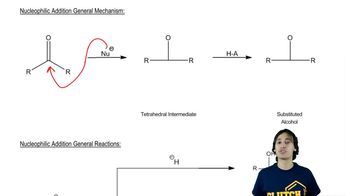
Nucleophilic addition is a fundamental reaction in organic chemistry where a nucleophile attacks an electrophilic carbon atom, typically in carbonyl compounds. This process leads to the formation of a new bond and is crucial for synthesizing various organic molecules. Understanding this mechanism is essential for predicting the outcomes of reactions involving compounds like ethyne.
Recommended video:
Guided course
08:27
Nucleophilic Addition

Alkylation

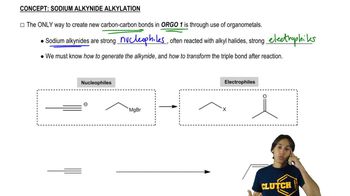
Alkylation refers to the introduction of an alkyl group into a molecule, often through a reaction with an alkyl halide. In the context of ethyne, alkylation can enhance the reactivity of the molecule, making it more favorable for subsequent nucleophilic addition. This step is important for controlling the structure and properties of the final product.
Recommended video:
Guided course
03:19
Sodium Alkynide Alkylation

Reactivity of Ethyne

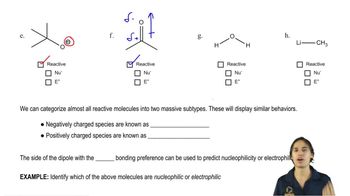
Ethyne, or acetylene, is a highly reactive alkyne due to its triple bond, which can participate in various chemical reactions. When considering the order of reactions, alkylating ethyne first can stabilize the resulting product and create a more favorable environment for nucleophilic addition. This strategic approach maximizes the efficiency of the overall synthetic pathway.
Recommended video:
Guided course
01:17
Reactivity of Molecules