Ch. 14 - NMR Spectroscopy
Bruice - Organic Chemistry 8th Edition
Bruice8th EditionOrganic ChemistryISBN: 9780135213711Not the one you use?Change textbook
Chapter 15, Problem 30

Why is there no coupling between the a and c protons or between the b and c protons in the cis and trans alkenes shown in Figure 14.20?
<IMAGE>

Verified step by step guidance
1
Step 1: Understand the concept of spin-spin coupling in NMR spectroscopy. Spin-spin coupling occurs when nuclei interact through the bonds connecting them, leading to splitting of NMR signals. This interaction depends on the number of bonds separating the nuclei and the spatial orientation of the bonds.
Step 2: Analyze the molecular structures of cis-3-bromopent-2-enoic acid and trans-3-bromopent-2-enoic acid. In both molecules, the protons labeled 'a', 'b', and 'c' are located on different parts of the molecule. Proton 'a' is directly attached to the double bond, proton 'b' is on the carbon adjacent to the double bond, and proton 'c' is part of the carboxylic acid group.
Step 3: Consider the spatial orientation of the bonds in the cis and trans isomers. In the cis isomer, the 'a' and 'c' protons are on the same side of the double bond, while in the trans isomer, they are on opposite sides. However, the 'a' and 'c' protons are separated by more than three bonds, which typically prevents spin-spin coupling.
Step 4: Examine the coupling between 'b' and 'c' protons. The 'b' proton is on a sp3-hybridized carbon, while the 'c' proton is part of the carboxylic acid group. These protons are separated by more than three bonds and are not in a spatial arrangement that allows coupling. Additionally, the electronegative oxygen atoms in the carboxylic acid group can disrupt coupling interactions.
Step 5: Conclude that there is no coupling between 'a' and 'c' protons or between 'b' and 'c' protons in both cis and trans isomers due to the lack of direct bond connectivity (more than three bonds apart) and unfavorable spatial orientation for coupling interactions.

Verified video answer for a similar problem:

This video solution was recommended by our tutors as helpful for the problem above.
Video duration:
4m
Was this helpful?

Key Concepts

Here are the essential concepts you must grasp in order to answer the question correctly.

Nuclear Magnetic Resonance (NMR) Spectroscopy

NMR spectroscopy is a powerful analytical technique used to determine the structure of organic compounds. It relies on the magnetic properties of certain nuclei, such as hydrogen, to provide information about the environment surrounding these nuclei. In the context of alkenes, NMR can reveal the coupling patterns between protons, which are influenced by their spatial arrangement and the presence of neighboring protons.
Recommended video:
Guided course
10:06
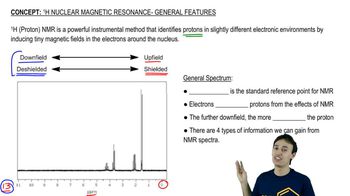
General NMR Features

Coupling Constants and Spin-Spin Coupling

Coupling constants are values that describe the interaction between nuclear spins of neighboring protons in NMR spectroscopy. Spin-spin coupling occurs when protons are close enough to influence each other's magnetic environment, leading to splitting of NMR signals. In the case of cis and trans alkenes, certain protons may not couple due to their geometric arrangement, resulting in distinct NMR patterns.
Recommended video:
Guided course
02:54
Sonogashira Coupling Reaction

Geometric Isomerism in Alkenes

Geometric isomerism refers to the different spatial arrangements of atoms in alkenes due to restricted rotation around the double bond. In cis isomers, substituents are on the same side, while in trans isomers, they are on opposite sides. This arrangement affects the coupling of protons in NMR; for example, protons on the same side may not couple due to their spatial orientation, leading to the absence of certain coupling patterns in the spectra.
Recommended video:
Guided course
06:47
Monosaccharides - D and L Isomerism