
Ch. 3 - Alkanes and Cycloalkanes: Properties and Conformational Analysis
Mullins - Organic Chemistry: A Learner Centered Approach 1st Edition
Mullins1st EditionOrganic Chemistry: A Learner Centered ApproachISBN: 9780137566471Not the one you use?Change textbook
Chapter 2, Problem 22b

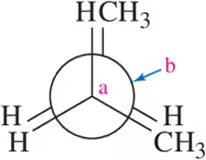
Using the Newman projections shown, draw each molecule in its line-angle drawing with all hydrogens and substituents shown. [Carbon b is behind carbon a in these structures.] Wedges and dashes should be used to indicate whether a substituent is coming out of, or going into, the plane of the page.
(b) Newman projection diagram showing two carbon atoms with substituents and hydrogens, indicating spatial arrangement with labels a and b.

Verified step by step guidance
1
Step 1: Understand the Newman projection. A Newman projection is a way to visualize the spatial arrangement of atoms around a bond. In this case, carbon 'a' is in the front, and carbon 'b' is behind. Identify the substituents attached to each carbon and their relative positions (e.g., staggered or eclipsed).
Step 2: Translate the Newman projection into a 3D perspective. For carbon 'a' (front carbon), draw the substituents radiating outward from the center. Use wedges to indicate substituents coming out of the plane of the page and dashes for substituents going into the plane of the page.
Step 3: For carbon 'b' (back carbon), position its substituents behind carbon 'a' in the drawing. Ensure the substituents are correctly aligned based on the Newman projection (e.g., staggered or eclipsed).
Step 4: Connect the two carbons with a single bond. Ensure the spatial arrangement of substituents matches the Newman projection. Double-check the orientation of wedges and dashes to accurately represent the 3D structure.
Step 5: Add all hydrogens and substituents explicitly in the line-angle drawing. Verify that the final structure matches the Newman projection and includes all necessary details, such as bond angles and substituent positions.

Verified video answer for a similar problem:

This video solution was recommended by our tutors as helpful for the problem above.
Video duration:
3m
Was this helpful?

Key Concepts

Here are the essential concepts you must grasp in order to answer the question correctly.

Newman Projections

Newman projections are a way to visualize the conformation of a molecule by looking straight down the bond connecting two carbon atoms. This representation helps in understanding the spatial arrangement of substituents around the bond, which is crucial for analyzing steric interactions and torsional strain in organic molecules.
Recommended video:
Guided course
00:34
Introduction to Drawing Newman Projections

Line-Angle Drawings

Line-angle drawings, also known as skeletal structures, are a shorthand way of representing organic molecules. In these drawings, carbon atoms are represented by the ends and intersections of lines, while hydrogen atoms are often omitted for simplicity. Understanding how to convert Newman projections into line-angle drawings is essential for accurately depicting molecular structures.
Recommended video:
Guided course
02:46
What is angle strain?

Wedges and Dashes

Wedges and dashes are used in structural representations to indicate the three-dimensional orientation of substituents on a molecule. A wedge (solid triangle) shows that a substituent is coming out of the plane of the page, while a dash (dashed line) indicates that it is going into the plane. This notation is vital for conveying the stereochemistry of a molecule accurately.
Recommended video:
3:03
Steroids Concept 3