Ch. 9 - Substitution and Elimination Reactions of Alkyl Halides
Bruice - Organic Chemistry 8th Edition
Bruice8th EditionOrganic ChemistryISBN: 9780135213711Not the one you use?Change textbook
Chapter 10, Problem 75

The pKa of acetic acid in water is 4.76. What effect will a decrease in the polarity of the solvent have on the pKa? Why?

Verified step by step guidance
1
Understand the relationship between pKa and the acidity of a compound: pKa is inversely related to the strength of an acid. A lower pKa indicates a stronger acid, while a higher pKa indicates a weaker acid.
Recognize the role of solvent polarity in stabilizing charged species: In a polar solvent like water, the dissociation of acetic acid (CH₃COOH) into CH₃COO⁻ (acetate ion) and H⁺ (proton) is stabilized because the polar solvent can solvate and stabilize these charged species.
Consider the effect of decreasing solvent polarity: A less polar solvent will be less effective at stabilizing the charged species (CH₃COO⁻ and H⁺) formed during dissociation. This makes the dissociation process less favorable.
Relate this to the pKa value: Since the dissociation of acetic acid is less favorable in a less polar solvent, the equilibrium will shift toward the undissociated form (CH₃COOH). This results in a higher pKa value, indicating that acetic acid is a weaker acid in a less polar solvent.
Conclude the reasoning: A decrease in the polarity of the solvent will increase the pKa of acetic acid because the solvent's reduced ability to stabilize the charged dissociation products makes the acid less likely to donate a proton.

Verified video answer for a similar problem:

This video solution was recommended by our tutors as helpful for the problem above.
Video duration:
5m
Was this helpful?

Key Concepts

Here are the essential concepts you must grasp in order to answer the question correctly.

pKa and Acid Strength

pKa is a measure of the acidity of a compound, indicating the strength of an acid in solution. A lower pKa value corresponds to a stronger acid, as it reflects a greater tendency to donate protons (H+ ions). Understanding pKa is essential for predicting how changes in the environment, such as solvent polarity, can influence acid behavior.
Recommended video:
Guided course
07:45
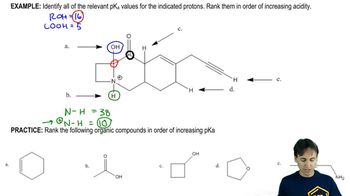
Identifying pKa values

Solvent Polarity

Solvent polarity refers to the ability of a solvent to stabilize charged species. Polar solvents, like water, can effectively stabilize ions through solvation, which affects the dissociation of acids. A decrease in solvent polarity means that the solvent is less capable of stabilizing the ions produced when an acid dissociates, which can lead to changes in the acid's pKa.
Recommended video:
Guided course
01:16
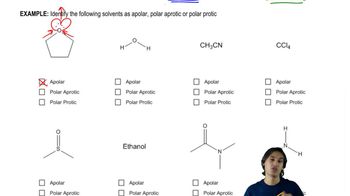
Identification of polarity in solvents

Le Chatelier's Principle

Le Chatelier's Principle states that if a system at equilibrium is subjected to a change in conditions, the system will adjust to counteract that change. In the context of acid dissociation, if the solvent's polarity decreases, the equilibrium may shift to favor the undissociated form of the acid, resulting in an increase in pKa, indicating a weaker acid in that solvent.
Recommended video:
Guided course
04:12
The Electron Configuration