Ch. 6 - The Reactions of Alkenes • The Stereochemistry of Addition Reactions
Bruice - Organic Chemistry 8th Edition
Bruice8th EditionOrganic ChemistryISBN: 9780135213711Not the one you use?Change textbook
Chapter 7, Problem 56a

Which electrophilic addition reactions
a. form a carbocation intermediate? intermediate?

Verified step by step guidance
1
Understand the concept of electrophilic addition reactions: These reactions involve the addition of an electrophile (electron-deficient species) to a compound, typically an alkene or alkyne, which contains a π-bond. The π-bond acts as a nucleophile, attacking the electrophile.
Recognize that some electrophilic addition reactions proceed through a carbocation intermediate. A carbocation is a positively charged carbon species that forms when the π-bond breaks, and one of the carbon atoms temporarily loses its share of the bonding electrons.
Identify common electrophilic addition reactions that form carbocation intermediates. Examples include: (1) Hydrohalogenation (addition of HX, where X is a halogen), and (2) Acid-catalyzed hydration (addition of water in the presence of an acid).
Analyze the mechanism of these reactions: In hydrohalogenation, the π-bond attacks the proton (H⁺) from HX, forming a carbocation intermediate. Similarly, in acid-catalyzed hydration, the π-bond attacks the proton from the acid, leading to the formation of a carbocation intermediate.
Note that the stability of the carbocation intermediate plays a critical role in determining the regioselectivity of the reaction. For example, in hydrohalogenation, the more stable carbocation (e.g., tertiary > secondary > primary) will form preferentially due to hyperconjugation and inductive effects.

Verified video answer for a similar problem:

This video solution was recommended by our tutors as helpful for the problem above.
Video duration:
3m
Was this helpful?

Key Concepts

Here are the essential concepts you must grasp in order to answer the question correctly.

Electrophilic Addition Reactions

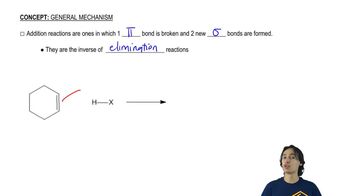
Electrophilic addition reactions are a class of organic reactions where an electrophile reacts with a nucleophile, typically involving alkenes or alkynes. In these reactions, the double or triple bond is broken, allowing new atoms or groups to be added to the molecule. Understanding the mechanism of these reactions is crucial for predicting the products formed.
Recommended video:
Guided course
05:39
Features of Addition Mechanisms.

Carbocation Intermediate

A carbocation intermediate is a positively charged species that contains a carbon atom with only six electrons in its valence shell, making it electron-deficient. Carbocations are often formed during electrophilic addition reactions when the electrophile attacks the nucleophile, leading to the formation of a temporary charged species. The stability of the carbocation can influence the reaction pathway and the final products.
Recommended video:
Guided course
00:47
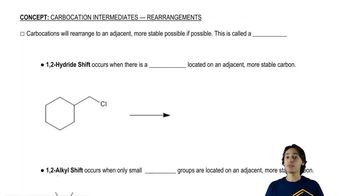
Understanding why carbocations shift.

Mechanism of Electrophilic Addition

The mechanism of electrophilic addition involves several steps, including the formation of a carbocation intermediate, nucleophilic attack, and deprotonation. The first step typically involves the electrophile attacking the alkene, resulting in the formation of a carbocation. Subsequent steps involve the nucleophile attacking the carbocation, leading to the final product. Understanding this mechanism is essential for predicting the outcomes of various electrophilic addition reactions.
Recommended video:
Guided course
05:39
Features of Addition Mechanisms.