Ch. 6 - Stereoisomerism: Arrangement of Atoms in Space
Mullins - Organic Chemistry: A Learner Centered Approach 1st Edition
Mullins1st EditionOrganic Chemistry: A Learner Centered ApproachISBN: 9780137566471Not the one you use?Change textbook
Chapter 5, Problem 47d

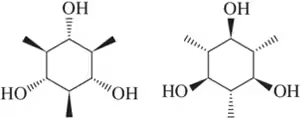
Define the relationship between each set of two molecules as chain isomers, positional isomers, functional group isomers, enantiomers, diastereomers, conformational isomers, or identical
(d) Two hexagonal molecular structures with hydroxyl groups, illustrating enantiomers in organic chemistry.

Verified step by step guidance
1
Step 1: Understand the definitions of the possible relationships between molecules. For example: - Chain isomers differ in the arrangement of the carbon skeleton. - Positional isomers differ in the position of a functional group or substituent on the same carbon chain. - Functional group isomers have different functional groups but the same molecular formula. - Enantiomers are non-superimposable mirror images of each other. - Diastereomers are stereoisomers that are not mirror images. - Conformational isomers differ by rotation around single bonds. - Identical molecules have the same structure and connectivity.
Step 2: Analyze the molecular formulas of the two molecules to confirm they are the same. If the molecular formulas differ, they are not isomers but completely different compounds.
Step 3: Compare the connectivity of atoms in the two molecules. If the connectivity differs, determine whether the difference is due to a change in the carbon chain (chain isomers) or the functional group (functional group isomers).
Step 4: If the connectivity is the same, examine the position of substituents or functional groups. If these differ, the molecules are positional isomers.
Step 5: If the connectivity and positions are the same, analyze the stereochemistry. Check for mirror image relationships (enantiomers), non-mirror image stereoisomers (diastereomers), or differences due to bond rotation (conformational isomers). If none of these apply, the molecules are identical.

Verified video answer for a similar problem:

This video solution was recommended by our tutors as helpful for the problem above.
Video duration:
7m
Was this helpful?

Key Concepts

Here are the essential concepts you must grasp in order to answer the question correctly.

Isomerism

Isomerism refers to the phenomenon where two or more compounds have the same molecular formula but different structural or spatial arrangements. This leads to distinct physical and chemical properties among the isomers. Understanding isomerism is crucial for distinguishing between various types of isomers, such as chain, positional, and functional group isomers.
Recommended video:
Guided course
06:47
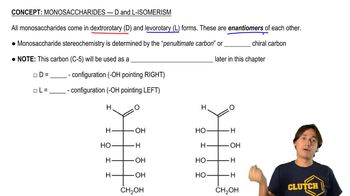
Monosaccharides - D and L Isomerism

Stereoisomers

Stereoisomers are a type of isomer that differ in the spatial arrangement of atoms, rather than the connectivity of atoms. This category includes enantiomers, which are non-superimposable mirror images, and diastereomers, which are not mirror images of each other. Recognizing stereoisomers is essential for understanding the three-dimensional aspects of molecular structures and their reactivity.
Recommended video:
Guided course
01:58
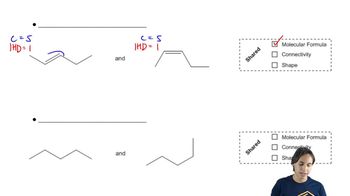
Determining when molecules are stereoisomers.

Conformational Isomers

Conformational isomers, or conformers, are different spatial arrangements of a molecule that result from rotation around single bonds. These isomers can interconvert through rotation, affecting the molecule's energy and stability. Understanding conformational isomers is important for analyzing the dynamic behavior of molecules in various chemical environments.
Recommended video:
Guided course
03:29
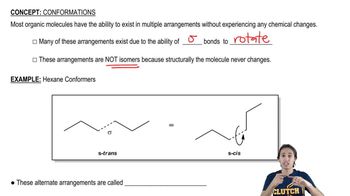
Understanding what a conformer is.