Ch. 13 - Alcohols, Ethers and Related Compounds: Substitution and Elimination
Mullins - Organic Chemistry: A Learner Centered Approach 1st Edition
Mullins1st EditionOrganic Chemistry: A Learner Centered ApproachISBN: 9780137566471Not the one you use?Change textbook
Chapter 12, Problem 17

Rationalize the difference in pKₐ values for the two hydroxyl groups.

Verified step by step guidance
1
Identify the two hydroxyl groups in the molecule: one is attached directly to the benzene ring (phenol group), and the other is part of an alcohol group attached to the benzyl position.
Recall that the pKₐ value is a measure of the acidity of a compound. A lower pKₐ indicates a stronger acid, meaning the proton is more easily donated.
Analyze the phenol group (pKₐ = 10): The hydroxyl group attached to the benzene ring is more acidic due to resonance stabilization. When the proton is lost, the resulting phenoxide ion is stabilized by delocalization of the negative charge across the aromatic ring.
Analyze the alcohol group (pKₐ = 16): The hydroxyl group attached to the benzyl position is less acidic because the conjugate base (alkoxide ion) does not benefit from resonance stabilization. The negative charge remains localized on the oxygen atom, making it less stable.
Compare the two groups: The difference in pKₐ values arises from the resonance stabilization of the phenoxide ion in the phenol group, which makes it easier to lose a proton compared to the alcohol group, where no such stabilization occurs.

Verified video answer for a similar problem:

This video solution was recommended by our tutors as helpful for the problem above.
Was this helpful?

Key Concepts

Here are the essential concepts you must grasp in order to answer the question correctly.

Acidity and pKa

pKa is a quantitative measure of the strength of an acid in solution, representing the negative logarithm of the acid dissociation constant (Ka). A lower pKa value indicates a stronger acid, meaning it dissociates more readily in solution. Understanding pKa is essential for comparing the acidity of different functional groups, such as hydroxyl groups in this case.
Recommended video:
Guided course
07:45
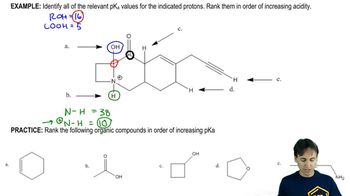
Identifying pKa values

Hydroxyl Groups

Hydroxyl groups (-OH) are functional groups that can influence the acidity of a compound. The position of the hydroxyl group relative to other substituents in a molecule can affect its ability to donate a proton, thus altering its pKa. Factors such as electronegativity and steric hindrance play significant roles in determining the acidity of hydroxyl groups.
Recommended video:
Guided course
04:42
Sequence Groups

Resonance and Inductive Effects

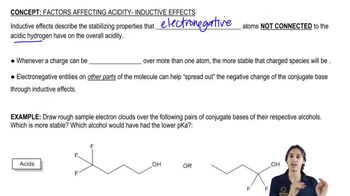
Resonance and inductive effects are key factors that can stabilize or destabilize the conjugate base formed after deprotonation of an acid. Resonance allows for the delocalization of negative charge, which can enhance stability and lower pKa. Inductive effects, caused by electronegative atoms or groups nearby, can either withdraw or donate electron density, further influencing the acidity of hydroxyl groups.
Recommended video:
Guided course
01:47
Understanding the Inductive Effect.