
Nitrogen has relatively stable isotopes (half-life greater than 1 second) of mass numbers 13, 14, 15, 16, and 17. All except 14N and 15N are radioactive.) Calculate how many protons and neutrons are in each of these isotopes of nitrogen.
Ch.1 - Structure and Bonding
Chapter 1, Problem 3,4i-k
Write Lewis structures for the following molecular formulas. Circle any lone pairs (pairs of nonbonding electrons) in the structures.
i. C3H6 (one double bond)
j. C3H4 (two double bonds)
k. C3H4 (one triple bond)
Verified step by step guidance1
Identify the total number of valence electrons for each molecule. For C3H6, C3H4 (two double bonds), and C3H4 (one triple bond), calculate the sum of valence electrons from carbon and hydrogen atoms.
For C3H6, arrange the carbon atoms in a chain and add a double bond between two of the carbon atoms. Distribute the remaining hydrogen atoms around the carbon atoms to satisfy the valency of carbon (four bonds per carbon atom).
For C3H4 with two double bonds, arrange the carbon atoms in a linear or branched structure. Introduce two double bonds between the carbon atoms. Distribute the hydrogen atoms to satisfy the valency of carbon.
For C3H4 with one triple bond, arrange the carbon atoms in a linear structure. Introduce a triple bond between two carbon atoms and a single bond between the remaining carbon atom and one of the triple-bonded carbons. Distribute the hydrogen atoms to satisfy the valency of carbon.
Circle any lone pairs of electrons on the carbon atoms, if present, after ensuring that all atoms have satisfied their valency. Typically, in these hydrocarbons, there are no lone pairs on carbon, but ensure all hydrogen atoms are bonded and all carbon atoms have four bonds.

Verified video answer for a similar problem:
This video solution was recommended by our tutors as helpful for the problem above.
Video duration:
10mWas this helpful?
Key Concepts
Here are the essential concepts you must grasp in order to answer the question correctly.
Lewis Structures
Lewis structures are diagrams that represent the bonding between atoms of a molecule and the lone pairs of electrons that may exist. They are essential for visualizing the arrangement of atoms, the distribution of electrons, and the types of bonds (single, double, or triple) present in a molecule. Understanding how to draw Lewis structures helps in predicting molecular geometry, reactivity, and properties.
Recommended video:
Guided course
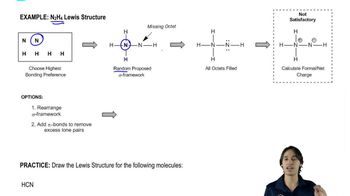
Drawing the Lewis Structure for N2H4.
Double and Triple Bonds
Double and triple bonds are types of covalent bonds where two or three pairs of electrons are shared between two atoms, respectively. A double bond consists of one sigma and one pi bond, while a triple bond consists of one sigma and two pi bonds. These bonds affect the molecule's geometry and reactivity, with triple bonds being shorter and stronger than double bonds.
Recommended video:
Guided course
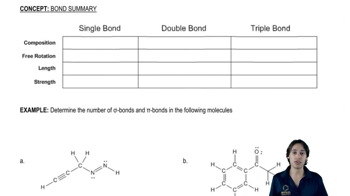
Single bonds, double bonds, and triple bonds.
Lone Pairs
Lone pairs are pairs of valence electrons that are not involved in bonding and belong exclusively to one atom. In Lewis structures, they are represented as pairs of dots around the atom. Lone pairs can influence the shape and polarity of a molecule, as they occupy space and can repel bonding pairs, affecting bond angles and molecular geometry.
Recommended video:
Guided course
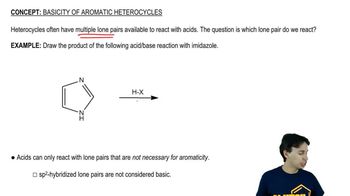
Heterocycles - Which lone pairs react?
Related Practice
Textbook Question
1896
views
Textbook Question
Use electronegativities to predict the direction of the dipole moments of the following bonds.
(f) N—Cl
(g) N—O
(h) N—S
(i) N—B
(j) B—Cl
2459
views
Textbook Question
Draw Lewis structures for the following compounds and ions, showing appropriate formal charges.
(e) +CH3
(f) –CH3
(g) NaBH4
(h) NaBH3CN
2205
views
Textbook Question
Draw Lewis structures for the following compounds.
e. dimethylamine, CH3NHCH3
f. diethyl ether, CH3CH2OCH2CH3
g. 1-chloropropane,CH3CH2CH2Cl
1278
views
Textbook Question
Write the electronic configurations of the third-row elements shown in the partial periodic table in Figure 1-6.
1531
views
Textbook Question
Draw Lewis structures for the following compounds and ions, showing appropriate formal charges.
(i) (CH3)2O—BF3
(j) [HONH3]+
(k) KOC(CH3)3
(l) [H2C=OH]+
2250
views
