Ch. 4 - Acids and Bases: Electron Flow
Mullins - Organic Chemistry: A Learner Centered Approach 1st Edition
Mullins1st EditionOrganic Chemistry: A Learner Centered ApproachISBN: 9780137566471Not the one you use?Change textbook
Chapter 3, Problem 51c

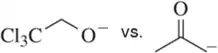
Identify the most stable conjugate base in each pair. Tell which structural features you analyzed and why you weighted them as you did in picking one answer.
(c) Comparison of two conjugate bases: trichloromethyl oxide and acetate, highlighting stability factors.

Verified step by step guidance
1
Step 1: Begin by recalling that the stability of a conjugate base is influenced by factors such as electronegativity, resonance stabilization, inductive effects, and hybridization. These features determine how well the conjugate base can stabilize the negative charge.
Step 2: Examine the structural features of the two conjugate bases in the pair. Look for resonance structures that can delocalize the negative charge, as resonance stabilization significantly increases stability.
Step 3: Evaluate the electronegativity of the atom bearing the negative charge. A more electronegative atom will better stabilize the negative charge, making the conjugate base more stable.
Step 4: Consider any inductive effects from nearby electronegative atoms or groups. These effects can pull electron density away from the negatively charged atom, further stabilizing the conjugate base.
Step 5: Analyze the hybridization of the atom holding the negative charge. A negative charge on an sp-hybridized atom is more stable than on an sp2 or sp3-hybridized atom due to the increased s-character, which holds the electrons closer to the nucleus.

Verified video answer for a similar problem:

This video solution was recommended by our tutors as helpful for the problem above.
Video duration:
4m
Was this helpful?

Key Concepts

Here are the essential concepts you must grasp in order to answer the question correctly.

Conjugate Bases

A conjugate base is the species that remains after an acid donates a proton (H+). The stability of a conjugate base is crucial in determining the strength of its corresponding acid; stronger acids have more stable conjugate bases. Factors influencing stability include electronegativity, resonance, and the size of the atom bearing the negative charge.
Recommended video:
Guided course
03:27
Conjugated states

Resonance Stabilization

Resonance stabilization occurs when a negative charge can be delocalized over multiple atoms through π bonds or lone pairs. This delocalization lowers the energy of the conjugate base, making it more stable. When comparing conjugate bases, those that can participate in resonance are typically favored due to their increased stability.
Recommended video:
Guided course
03:43
The radical stability trend.

Electronegativity and Charge Distribution

Electronegativity refers to the ability of an atom to attract electrons. In the context of conjugate bases, a more electronegative atom stabilizes a negative charge better than a less electronegative one. When analyzing conjugate bases, the distribution of the negative charge relative to electronegativity helps determine which base is more stable, as charge localization on electronegative atoms is energetically favorable.
Recommended video:
Guided course
1:47
Electronegativity