Ch. 5 - Alkenes: Structure, Nomenclature, and an Introduction to Reactivity • Thermodynamics and Kinetics
Bruice - Organic Chemistry 8th Edition
Bruice8th EditionOrganic ChemistryISBN: 9780135213711Not the one you use?Change textbook
Chapter 6, Problem 43d,e,f

Draw the skeletal structures for the compounds in Problem 42.
d. vinyl bromide
e. 1,2-dimethylcyclopentene
f. diallylamine

Verified step by step guidance
1
Step 1: Understand the naming conventions for each compound. For 'vinyl bromide,' the 'vinyl' group refers to an ethene group (CH₂=CH-) attached to another atom or group. Bromide indicates the presence of a bromine atom.
Step 2: Draw the skeletal structure for vinyl bromide. Start with the ethene backbone (CH₂=CH-) and attach a bromine atom to one of the carbons in the double bond.
Step 3: For '1,2-dimethylcyclopentene,' recognize that the base structure is cyclopentene, a five-membered ring with one double bond. The '1,2-dimethyl' indicates two methyl groups attached to the first and second carbons of the ring.
Step 4: Draw the skeletal structure for 1,2-dimethylcyclopentene. Begin with a five-membered ring containing one double bond, then add methyl groups (-CH₃) to the first and second carbons of the ring.
Step 5: For 'diallylamine,' note that 'allyl' refers to the CH₂=CH-CH₂- group. 'Diallyl' means two allyl groups are attached to the amine (NH₂). Draw the skeletal structure by connecting two allyl groups to the nitrogen atom of the amine.

Verified video answer for a similar problem:

This video solution was recommended by our tutors as helpful for the problem above.
Video duration:
6m
Was this helpful?

Key Concepts

Here are the essential concepts you must grasp in order to answer the question correctly.

Skeletal Structures

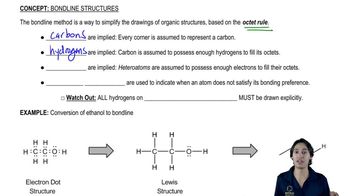
Skeletal structures are simplified representations of organic molecules that depict the arrangement of atoms and bonds without showing all the hydrogen atoms explicitly. In these diagrams, carbon atoms are represented by vertices or line ends, while bonds are shown as lines. This notation helps chemists visualize molecular structure and connectivity efficiently.
Recommended video:
Guided course
04:03
How bondline is different from Lewis Structures.

Vinyl Compounds

Vinyl compounds are organic molecules that contain a vinyl group, which is characterized by the presence of a carbon-carbon double bond (C=C) adjacent to a carbon atom that is bonded to another substituent. Vinyl bromide, for example, has a bromine atom attached to a vinyl group, making it a key compound in various chemical reactions, including polymerization.
Recommended video:
Guided course
01:40
Defining meso compounds.

Cycloalkenes

Cycloalkenes are cyclic hydrocarbons that contain at least one carbon-carbon double bond within the ring structure. In the case of 1,2-dimethylcyclopentene, the compound features a five-membered carbon ring with two methyl groups attached to the first and second carbon atoms. Understanding the geometry and reactivity of cycloalkenes is essential for predicting their behavior in chemical reactions.
Recommended video:
Guided course
01:11
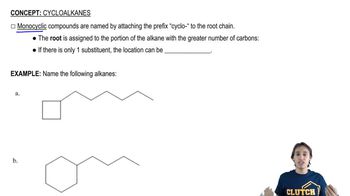
How to find the root name for cycloalkanes