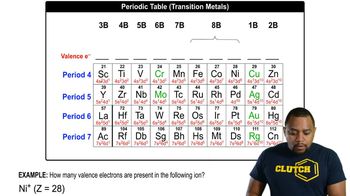
Step 1: Identify the molecular formula C₂H₆O and determine the total number of valence electrons. Carbon (C) has 4 valence electrons, hydrogen (H) has 1 valence electron, and oxygen (O) has 6 valence electrons. Calculate the total valence electrons: (2 × 4) + (6 × 1) + (1 × 6) = 20 valence electrons.
Step 2: Recognize that C₂H₆O can form two distinct isomers: ethanol (an alcohol) and dimethyl ether (an ether). These isomers differ in the connectivity of their atoms.
Step 3: For ethanol, arrange the atoms such that one carbon is bonded to three hydrogens, the second carbon is bonded to two hydrogens and an oxygen, and the oxygen is bonded to a hydrogen. Ensure all atoms satisfy the octet rule (or duet rule for hydrogen).
Step 4: For dimethyl ether, arrange the atoms such that the oxygen is bonded to two carbons, and each carbon is bonded to three hydrogens. Again, ensure all atoms satisfy the octet rule (or duet rule for hydrogen).
Step 5: Draw the Lewis structures for both isomers. For ethanol, the structure will show a C-C-O-H backbone with appropriate single bonds and lone pairs on oxygen. For dimethyl ether, the structure will show a C-O-C backbone with appropriate single bonds and lone pairs on oxygen.
Verified video answer for a similar problem:
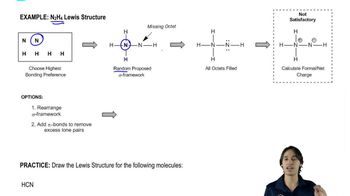
This video solution was recommended by our tutors as helpful for the problem above
Video duration:
4m
Play a video:
0 Comments
Key Concepts
Here are the essential concepts you must grasp in order to answer the question correctly.
Lewis Structures
Lewis structures are diagrams that represent the bonding between atoms in a molecule and the lone pairs of electrons that may exist. They use dots to represent electrons and lines to represent bonds between atoms. Understanding how to draw Lewis structures is essential for visualizing molecular geometry and predicting reactivity.
Valence electrons are the outermost electrons of an atom and are crucial in determining how atoms bond with each other. In the case of C2H6O, counting the total number of valence electrons helps in constructing accurate Lewis structures. Carbon has four, hydrogen has one, and oxygen has six, leading to a total of 14 valence electrons for C2H6O.
Resonance structures are different ways of drawing the same molecule that show the delocalization of electrons. For C2H6O, drawing multiple Lewis structures can illustrate how electrons are shared or distributed differently among atoms. Recognizing resonance is important for understanding the stability and reactivity of molecules.