
Ch. 4 - Isomers: The Arrangement of Atoms in Space
Bruice - Organic Chemistry 8th Edition
Bruice8th EditionOrganic ChemistryISBN: 9780135213711Not the one you use?Change textbook
Chapter 5, Problem 102b

For each pair, indicate which conformer is more stable.

Verified step by step guidance
1
Step 1: Analyze the chair conformations for both pairs (i) and (ii). In chair conformations, substituents can occupy axial (vertical) or equatorial (angled) positions. Equatorial positions are generally more stable due to reduced steric hindrance.
Step 2: For pair (i), observe the positions of the substituents in Conformer A and Conformer B. In Conformer A, the CH₃ group is equatorial, and the bulky CH(CH₃)₂ group is axial. In Conformer B, the CH₃ group is axial, and the bulky CH(CH₃)₂ group is equatorial. Bulky groups prefer equatorial positions to minimize steric hindrance.
Step 3: For pair (ii), observe the positions of the substituents in Conformer A and Conformer B. In Conformer A, the bulky CH(CH₃)₂ group is equatorial, and the CH₃ group is axial. In Conformer B, the CH₃ group is equatorial, and the bulky CH(CH₃)₂ group is axial. Again, bulky groups prefer equatorial positions to minimize steric hindrance.
Step 4: Compare the stability of the conformers in each pair based on steric hindrance. The conformer with the bulky group in the equatorial position will be more stable.
Step 5: Conclude that for pair (i), Conformer B is more stable because the bulky CH(CH₃)₂ group is equatorial. For pair (ii), Conformer A is more stable because the bulky CH(CH₃)₂ group is equatorial.

Verified video answer for a similar problem:

This video solution was recommended by our tutors as helpful for the problem above.
Video duration:
2m
Was this helpful?

Key Concepts

Here are the essential concepts you must grasp in order to answer the question correctly.

Conformational Analysis

Conformational analysis involves studying the different spatial arrangements of atoms in a molecule that can be interconverted by rotation around single bonds. In alkanes, these conformers can adopt various shapes, affecting their stability due to steric interactions and torsional strain. Understanding these conformations is crucial for predicting the most stable form of a molecule.
Recommended video:
Guided course
03:29
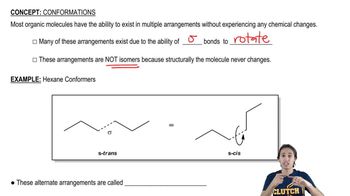
Understanding what a conformer is.

Steric Hindrance

Steric hindrance refers to the repulsion between bulky groups within a molecule that can lead to increased energy and decreased stability. In conformers, steric hindrance can arise when larger substituents are positioned close to each other, causing strain. Identifying which conformer minimizes steric hindrance is essential for determining stability.
Recommended video:
Guided course
02:53
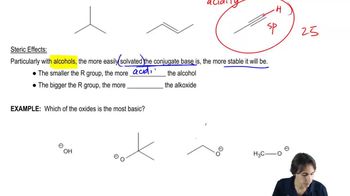
Understanding steric effects.

Torsional Strain

Torsional strain occurs when atoms in a molecule are eclipsed or partially eclipsed, leading to increased energy due to repulsion between electron clouds. In conformers, this strain is particularly relevant when analyzing staggered versus eclipsed arrangements. A conformer that minimizes torsional strain is generally more stable, making it a key factor in conformational stability.
Recommended video:
Guided course
02:00
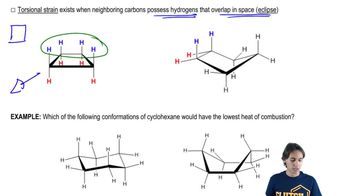
What is torsional strain?