Ch. 9 - Substitution and Elimination Reactions of Alkyl Halides
Bruice - Organic Chemistry 8th Edition
Bruice8th EditionOrganic ChemistryISBN: 9780135213711Not the one you use?Change textbook
Chapter 10, Problem 64a,b

After a proton is removed from the OH group, which compound in each pair forms a cyclic ether more rapidly?
a. Chemical structures comparing two compounds with hydroxyl and bromine groups, questioning which forms a cyclic ether faster.
b. Chemical structures showing two pairs of compounds with hydroxyl (OH) and bromine (Br) groups for comparison.

Verified step by step guidance
1
Step 1: Analyze the structure of each compound in the pairs (a and b). Both compounds in each pair contain an OH group and a Cl group, which can participate in an intramolecular reaction to form a cyclic ether.
Step 2: Consider the mechanism of cyclic ether formation. This typically involves the removal of a proton from the OH group, followed by a nucleophilic attack of the oxygen on the carbon attached to the chlorine atom, leading to the formation of a cyclic ether.
Step 3: Evaluate the ring size that would be formed in each case. Smaller rings (e.g., 5- or 6-membered rings) are generally more stable due to reduced ring strain compared to larger rings.
Step 4: Compare the distance between the OH group and the Cl group in each compound. In pair (a), compound (i) forms a 5-membered ring, while compound (ii) forms a 6-membered ring. In pair (b), compound (i) forms a 4-membered ring, while compound (ii) forms a 5-membered ring.
Step 5: Based on ring stability, predict which compound in each pair forms a cyclic ether more rapidly. Compound (ii) in pair (a) is likely to form a cyclic ether more rapidly due to the stability of the 6-membered ring. Compound (ii) in pair (b) is likely to form a cyclic ether more rapidly due to the stability of the 5-membered ring compared to the 4-membered ring.

Verified video answer for a similar problem:

This video solution was recommended by our tutors as helpful for the problem above.
Video duration:
3m
Was this helpful?

Key Concepts

Here are the essential concepts you must grasp in order to answer the question correctly.

Cyclic Ether Formation

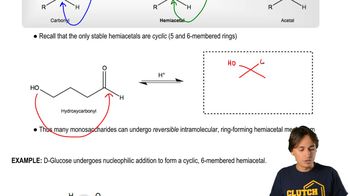
Cyclic ethers are formed through intramolecular reactions where a hydroxyl group (OH) reacts with a leaving group, typically resulting in the formation of a ring structure. The stability of the cyclic ether and the rate of formation depend on the sterics and electronics of the reactants, as well as the ability of the leaving group to depart effectively.
Recommended video:
Guided course
06:23
Monosaccharides - Forming Cyclic Hemiacetals

Protonation and Leaving Groups

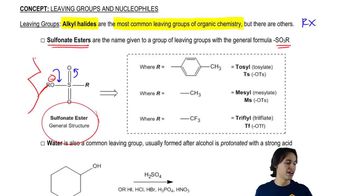
In organic reactions, the removal of a proton from an alcohol group enhances the nucleophilicity of the oxygen atom, making it more reactive towards electrophiles. The presence of a good leaving group, such as a halide, is crucial as it facilitates the formation of the cyclic ether by allowing the nucleophile to attack and form a bond while the leaving group departs.
Recommended video:
Guided course
07:22
The 3 important leaving groups to know.

Steric Hindrance

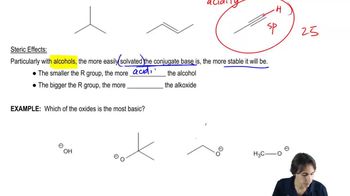
Steric hindrance refers to the repulsion between bulky groups in a molecule that can impede reactions. In the context of cyclic ether formation, steric hindrance can affect the accessibility of the hydroxyl group to the electrophile, influencing the rate at which the cyclic ether is formed. Less hindered structures typically react more rapidly than those with significant steric bulk.
Recommended video:
Guided course
02:53
Understanding steric effects.