Ch. 20 - Carboxylic Acids
Wade - Organic Chemistry 9th Edition
Wade9th EditionOrganic ChemistryISBN: 9780135213728Not the one you use?Change textbook
Chapter 20, Problem 17b

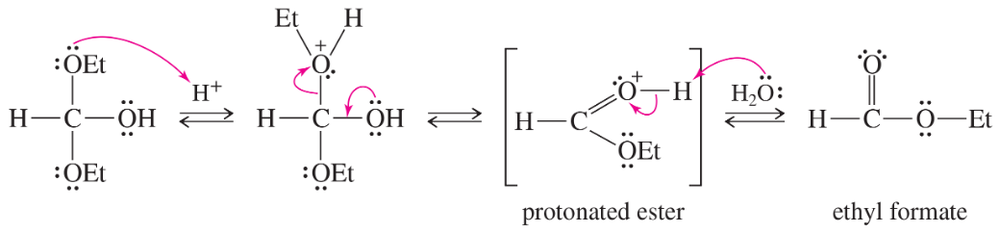
(b) Finish the solution for Solved Problem 20-1 by providing a mechanism for the acid-catalyzed hydrolysis of ethyl formate.

Verified step by step guidance
1
Identify the reaction type: The problem involves the acid-catalyzed hydrolysis of ethyl formate, which is an ester. This reaction will produce a carboxylic acid (formic acid) and an alcohol (ethanol). The mechanism proceeds through nucleophilic acyl substitution under acidic conditions.
Step 1: Protonation of the ester carbonyl group. The acid catalyst (H⁺) protonates the carbonyl oxygen of ethyl formate, increasing the electrophilicity of the carbonyl carbon. This makes it more susceptible to nucleophilic attack.
Step 2: Nucleophilic attack by water. A water molecule acts as a nucleophile and attacks the carbonyl carbon, forming a tetrahedral intermediate. This intermediate contains a positively charged oxygen atom due to the protonated carbonyl group.
Step 3: Proton transfer. A proton transfer occurs within the intermediate to stabilize the structure. The hydroxyl group (from water) becomes neutral, and one of the ethoxy groups is protonated, making it a good leaving group.
Step 4: Elimination of the leaving group and deprotonation. The ethoxy group (C₂H₅O⁺) leaves, forming ethanol. The remaining intermediate is protonated formic acid, which undergoes deprotonation to yield the final product: formic acid (HCOOH).

Verified video answer for a similar problem:

This video solution was recommended by our tutors as helpful for the problem above.
Video duration:
4m
Was this helpful?

Key Concepts

Here are the essential concepts you must grasp in order to answer the question correctly.

Acid-Catalyzed Hydrolysis

Acid-catalyzed hydrolysis is a reaction where water is used to break down a compound in the presence of an acid, which increases the reaction rate. In this process, the acid donates protons (H+) to the reactants, facilitating the cleavage of bonds and the formation of products. This mechanism is crucial for understanding how esters, like ethyl formate, are converted into their corresponding acids and alcohols.
Recommended video:
Guided course
03:09
Acid Catalyzed

Mechanism of Ester Hydrolysis

The mechanism of ester hydrolysis involves several key steps: protonation of the carbonyl oxygen, nucleophilic attack by water, and subsequent deprotonation. Initially, the acid protonates the carbonyl oxygen, increasing the electrophilicity of the carbon atom. Water then acts as a nucleophile, attacking the carbonyl carbon, leading to the formation of a tetrahedral intermediate, which eventually collapses to yield the acid and alcohol.
Recommended video:
0:48
Hydrolysis of Phosphate Esters Concept 2

Role of Ethyl Formate

Ethyl formate is an ester formed from formic acid and ethanol. In the context of acid-catalyzed hydrolysis, it serves as the substrate that undergoes reaction with water in the presence of an acid catalyst. Understanding the structure and reactivity of ethyl formate is essential for predicting the products of the hydrolysis reaction, which will yield formic acid and ethanol.
Recommended video:
Guided course
02:26
Formation of Enolates
Related Practice
Textbook Question

Show how Fischer esterification might be used to form the following esters. In each case, suggest a method for driving the reaction to completion.

(c) ethyl phenylacetate

1187
views

Textbook Question

Show how to synthesize the following compounds, using appropriate carboxylic acids and amines.

(b)

665
views
Textbook Question

The mechanism of the Fischer esterification was controversial until 1938, when Irving Roberts and Harold Urey of Columbia University used isotopic labeling to follow the alcohol oxygen atom through the reaction. A catalytic amount of sulfuric acid was added to a mixture of 1 mole of acetic acid and 1 mole of special methanol containing the heavy 18O isotope of oxygen. After a short period, the acid was neutralized to stop the reaction, and the components of the mixture were separated.

(a) Propose a mechanism for this reaction.

(b) Follow the labeled 18O atom through your mechanism, and show where it is found in the products.

951
views
Textbook Question

Show how to synthesize the following compounds, using appropriate carboxylic acids and amines.

(a)

694
views
Textbook Question

The given was missing some important resonance forms of the intermediates shown in brackets. Complete this mechanism by drawing all the resonance forms of these intermediates. Do your resonance forms help to explain why this reaction occurs under very mild conditions (water with a tiny trace of acid)?

1016
views
Textbook Question

Show how to synthesize the following compounds, using appropriate carboxylic acids and amines.

(c)

616
views