
Ch. 23 - Benzene I: Aromatic Stability and Substitution Reactions
Mullins - Organic Chemistry: A Learner Centered Approach 1st Edition
Mullins1st EditionOrganic Chemistry: A Learner Centered ApproachISBN: 9780137566471Not the one you use?Change textbook
Chapter 22, Problem 14

Which resonance structure, A or B, is most contributing?
Resonance structures A and B are shown, with a question about which is the most contributing structure.

Verified step by step guidance
1
Examine the resonance structures A and B. Structure A has a positive charge on the five-membered ring and a negative charge on the seven-membered ring, while structure B has a negative charge on the five-membered ring and a positive charge on the seven-membered ring.
Consider the stability of the charges in each structure. In general, a negative charge is more stable on a more electronegative atom, and a positive charge is more stable on a less electronegative atom.
Analyze the aromaticity of each structure. Aromatic compounds are more stable due to resonance stabilization. Check if the placement of charges affects the aromaticity of the rings.
Evaluate the resonance stabilization. The structure that allows for more delocalization of electrons and maintains aromaticity is typically more stable and thus more contributing.
Determine which structure has the least separation of charges. Structures with less charge separation are generally more stable and contribute more to the resonance hybrid.

Verified video answer for a similar problem:

This video solution was recommended by our tutors as helpful for the problem above.
Was this helpful?

Key Concepts

Here are the essential concepts you must grasp in order to answer the question correctly.

Resonance Structures

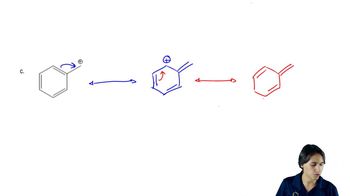
Resonance structures are different Lewis structures for the same molecule that depict the delocalization of electrons. They are used to represent molecules where the electron distribution cannot be described by a single Lewis structure. The true structure is a hybrid of all resonance forms, with some contributing more to the hybrid than others.
Recommended video:
Guided course
03:04
Drawing Resonance Structures

Stability of Resonance Structures

The stability of resonance structures is determined by several factors, including the number of covalent bonds, the presence of full octets, and the distribution of charges. Structures with more covalent bonds, complete octets, and minimal charge separation are generally more stable and contribute more to the resonance hybrid.
Recommended video:
Guided course
03:04
Drawing Resonance Structures

Charge Distribution

Charge distribution in resonance structures affects their stability. Structures with charges on more electronegative atoms are more stable. In the given structures, the placement of positive and negative charges on different atoms can influence which structure is more contributing, with less charge separation being preferable.
Recommended video:
Guided course
01:34
Calculating formal and net charge.