
Ch. 17 - Reactions of Aromatic Compounds
Wade - Organic Chemistry 9th Edition
Wade9th EditionOrganic ChemistryISBN: 9780135213728Not the one you use?Change textbook
Chapter 17, Problem 74

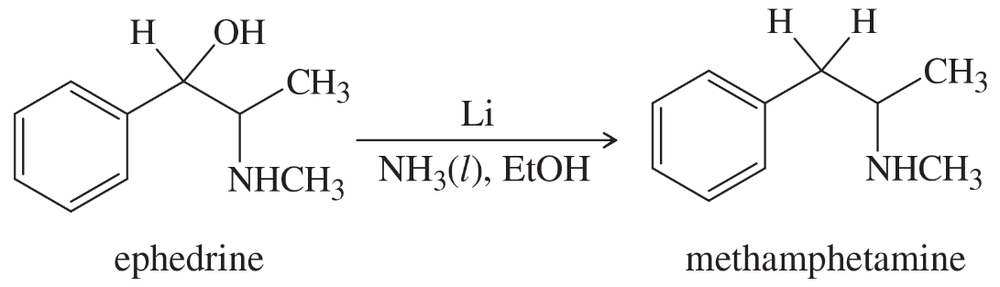
A common illicit synthesis of methamphetamine involves an interesting variation of the Birch reduction. A solution of ephedrine in alcohol is added to liquid ammonia, followed by several pieces of lithium metal. The Birch reduction usually reduces the aromatic ring (Section 17-14C), but in this case it eliminates the hydroxy group of ephedrine to give methamphetamine. Propose a mechanism, similar to that for the Birch reduction, to explain this unusual course of the reaction.

Verified step by step guidance
1
Step 1: Recognize that the reaction involves a Birch reduction-like mechanism. In a typical Birch reduction, aromatic rings are reduced using alkali metals (e.g., lithium) in liquid ammonia, often with an alcohol as a proton source. Here, the reaction eliminates the hydroxy group of ephedrine instead of reducing the aromatic ring.
Step 2: Analyze the role of lithium metal. Lithium donates electrons to form solvated electrons in liquid ammonia. These electrons are highly reactive and initiate the reduction process by attacking the substrate, in this case, ephedrine.
Step 3: Propose the first step of the mechanism. The solvated electron attacks the hydroxyl group of ephedrine, leading to the formation of a radical anion. This step destabilizes the hydroxyl group, making it susceptible to elimination.
Step 4: Suggest the elimination of the hydroxyl group. The radical anion undergoes protonation (from ethanol or ammonia) and subsequent elimination of the hydroxyl group as water, forming a carbocation intermediate.
Step 5: Complete the mechanism. The carbocation intermediate is stabilized by another solvated electron, forming a neutral radical. Protonation of this radical leads to the formation of methamphetamine, where the hydroxy group is replaced by a hydrogen atom.

Verified video answer for a similar problem:

This video solution was recommended by our tutors as helpful for the problem above.
Video duration:
8m
Was this helpful?

Key Concepts

Here are the essential concepts you must grasp in order to answer the question correctly.

Birch Reduction

The Birch reduction is a chemical reaction that involves the reduction of aromatic compounds using alkali metals (like lithium) in liquid ammonia, often in the presence of an alcohol. This reaction typically results in the formation of 1,4-cyclohexadienes by selectively reducing the aromatic ring. Understanding this mechanism is crucial for analyzing how similar reactions can lead to different products, such as the conversion of ephedrine to methamphetamine.

Mechanism of Reduction

The mechanism of reduction in organic chemistry describes the step-by-step process by which a compound gains electrons or hydrogen, leading to a decrease in oxidation state. In the case of the Birch reduction, the mechanism involves the formation of radical anions and subsequent protonation steps. Analyzing the specific steps in the mechanism helps explain how the hydroxy group of ephedrine is eliminated, resulting in the formation of methamphetamine.

Functional Group Transformation

Functional group transformation refers to the chemical processes that convert one functional group into another, altering the reactivity and properties of a molecule. In this reaction, the hydroxy group (-OH) of ephedrine is transformed into a hydrogen atom, effectively removing it and leading to the formation of methamphetamine. Understanding these transformations is essential for predicting the outcomes of organic reactions and designing synthetic pathways.
Related Practice
Textbook Question

Phenolphthalein, a common nonprescription laxative, is also an acid–base indicator that is colorless in acid and red in base. Phenolphthalein is synthesized by the acid-catalyzed reaction of phthalic anhydride with 2 equivalents of phenol.

a. Propose a mechanism for the synthesis of phenolphthalein.

2579
views
1
rank
Textbook Question

In Chapter 14, we saw that Agent Orange contains (2,4,5-trichlorophenoxy) acetic acid, called 2,4,5-T. This compound is synthesized by the partial reaction of 1,2,4,5-tetrachlorobenzene with sodium hydroxide, followed by reaction with sodium chloroacetate, ClCH2CO2Na.

a. Draw the structures of these compounds, and write equations for these reactions.

776
views
Textbook Question

Show how you would use a Suzuki reaction to synthesize the following biaryl compound. As starting materials, you may use the two indicated compounds, plus any additional reagents you need.

1378
views
Textbook Question

Phenol reacts with three equivalents of bromine in CCl4 (in the dark) to give a product of formula C6H3OBr3. When this product is added to bromine water, a yellow solid of molecular formula C6H2OBr4 precipitates out of the solution. The IR spectrum of the yellow precipitate shows a strong absorption (much like that of a quinone) around 1680 cm–1. Propose structures for the two products.

4536
views
Textbook Question

The antioxidants BHA and BHT are commonly used as food preservatives. Show how BHA and BHT can be made from phenol and hydroquinone

2179
views
Textbook Question

Starting with benzene and any other reagents you need, show how you would synthesize the compound shown here. (Hint: Consider a Pd-catalyzed coupling for the final step.)

2014
views
1
rank