Ch. 23 - Carbohydrates and Nucleic Acids
Wade - Organic Chemistry 9th Edition
Wade9th EditionOrganic ChemistryISBN: 9780135213728Not the one you use?Change textbook
Chapter 23, Problem 52e

Predict the products obtained when D-galactose reacts with each reagent.
(e) H2, Ni

Verified step by step guidance
1
Identify the structure of D-galactose: D-galactose is an aldohexose, meaning it contains six carbon atoms and an aldehyde functional group at the first carbon. The remaining carbons have hydroxyl (-OH) groups in specific stereochemical configurations.
Understand the reagent: H₂ with Ni is a catalytic hydrogenation system. This reagent typically reduces carbonyl groups (C=O) to alcohols (-OH) by adding hydrogen atoms.
Determine the site of reaction: In D-galactose, the aldehyde group (-CHO) at the first carbon is the primary site for reduction. The double bond in the carbonyl group will be reduced to a single bond, converting the aldehyde into a primary alcohol (-CH₂OH).
Predict the product: The reduction of the aldehyde group in D-galactose will result in the formation of D-galactitol (also known as dulcitol), which is a sugar alcohol. The stereochemistry of the other carbons remains unchanged during this reaction.
Summarize the reaction: The reaction converts D-galactose into D-galactitol by reducing the aldehyde group to a primary alcohol using H₂ and Ni as the catalyst.

Verified video answer for a similar problem:

This video solution was recommended by our tutors as helpful for the problem above.
Video duration:
1m
Was this helpful?

Key Concepts

Here are the essential concepts you must grasp in order to answer the question correctly.

Reduction Reactions

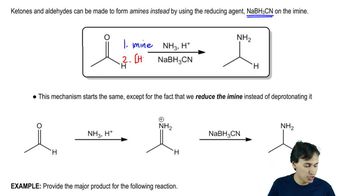
Reduction reactions involve the gain of electrons or hydrogen, or the loss of oxygen. In organic chemistry, this often refers to the conversion of carbonyl groups (like aldehydes and ketones) into alcohols. When d-galactose, a sugar with multiple hydroxyl groups and a carbonyl group, is treated with hydrogen gas (H2) in the presence of a nickel catalyst, the carbonyl group is reduced to an alcohol, leading to the formation of a sugar alcohol.
Recommended video:
Guided course
07:12
Reductive Amination

Catalytic Hydrogenation

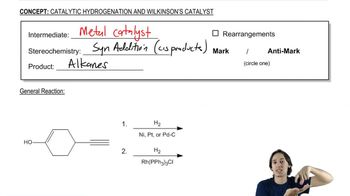
Catalytic hydrogenation is a specific type of reduction where hydrogen gas is added to a compound in the presence of a catalyst, such as nickel (Ni). This process is commonly used to convert unsaturated compounds into saturated ones. In the case of d-galactose, the presence of nickel facilitates the addition of hydrogen to the carbonyl group, effectively saturating it and transforming the sugar into a different structural form.
Recommended video:
Guided course
05:21
General properties of catalytic hydrogenation.

Stereochemistry of Sugars

Stereochemistry refers to the spatial arrangement of atoms in molecules and how this affects their chemical behavior. D-galactose is a stereoisomer of glucose, differing in the configuration around specific carbon atoms. Understanding the stereochemistry of d-galactose is crucial when predicting the products of its reactions, as the spatial arrangement can influence the outcome of reduction reactions and the properties of the resulting sugar alcohol.
Recommended video:
Guided course
08:42
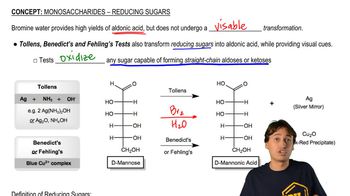
Reducing Sugars