Textbook Question
Why is a ketone more reactive/electrophilic than an ester?
2061
views

 Mullins 1st EditionCh. 19 - Nucleophilic Acyl Substitution II: Carboxylic Acid DerivativesProblem 40a
 Verified step by step guidance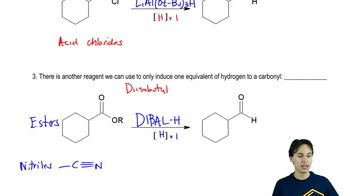
 02:10
02:10
 02:39 02:39
Why is a ketone more reactive/electrophilic than an ester?
The esters shown differ only by the alkoxy group.
(i) Predict the product(s) obtained when these react with DIBAl-H.
(ii) Based on your answer, in a sequence like this, would there ever be a need to convert from one ester to another?
(b)
Predict the product of the following reaction sequences.
(a)
Predict the product of the following reaction sequences.
(c)
Predict the product of the following reaction sequences.
(b)
When the ester attacked the aluminum of DIBAl-H, why did the carbonyl oxygen attack preferentially over the alkoxy oxygen?