Ch. 24 - Benzene II: Reactions Influenced by the Aromatic Ring
Mullins - Organic Chemistry: A Learner Centered Approach 1st Edition
Mullins1st EditionOrganic Chemistry: A Learner Centered ApproachISBN: 9780137566471Not the one you use?Change textbook
Chapter 23, Problem 50

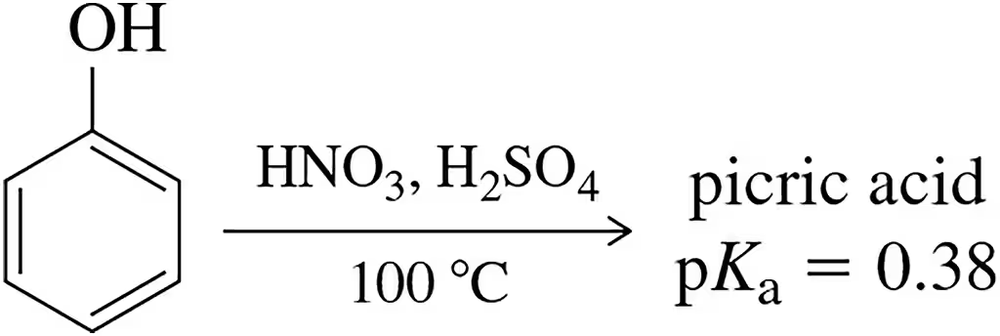
In Chapter 23, we learned about the electrophilic aromatic nitration reaction. When phenol is subjected to these conditions with a large excess of nitric acid, a molecule called picric acid is produced. Predict the product of this reaction and explain why the pKa value of this compound is 0.38.
Chemical reaction showing phenol reacting with nitric and sulfuric acids to produce picric acid, with pKa value of 0.38.

Verified step by step guidance
1
Step 1: Recognize that phenol (C₆H₅OH) undergoes electrophilic aromatic nitration when treated with concentrated nitric acid (HNO₃) and sulfuric acid (H₂SO₄). The hydroxyl (-OH) group on phenol is an activating group, making the aromatic ring highly reactive towards electrophilic substitution reactions.
Step 2: Understand the mechanism of nitration. The reaction involves the generation of the nitronium ion (NO₂⁺) as the electrophile, which is formed by the interaction of HNO₃ and H₂SO₄. The nitronium ion attacks the aromatic ring, leading to substitution at positions that are ortho and para to the hydroxyl group due to its electron-donating nature.
Step 3: Note that under the reaction conditions (large excess of nitric acid and elevated temperature), multiple nitration occurs. Phenol reacts to form 2,4,6-trinitrophenol, commonly known as picric acid. The hydroxyl group directs the nitro groups to the ortho and para positions relative to itself.
Step 4: Explain the pKa value of picric acid (0.38). The presence of three electron-withdrawing nitro groups (-NO₂) significantly increases the acidity of the hydroxyl group. These nitro groups stabilize the negative charge on the phenoxide ion formed after deprotonation, making picric acid a very strong acid compared to phenol.
Step 5: Summarize the reaction: Phenol reacts with concentrated HNO₃ and H₂SO₄ at 100°C to produce picric acid (2,4,6-trinitrophenol). The low pKa value is due to the strong electron-withdrawing effects of the nitro groups, which enhance the acidity of the compound.

Verified video answer for a similar problem:

This video solution was recommended by our tutors as helpful for the problem above.
Was this helpful?

Key Concepts

Here are the essential concepts you must grasp in order to answer the question correctly.

Electrophilic Aromatic Substitution

Electrophilic aromatic substitution (EAS) is a fundamental reaction in organic chemistry where an electrophile replaces a hydrogen atom on an aromatic ring. In the case of nitration, the electrophile is the nitronium ion (NO₂⁺), which attacks the electron-rich aromatic system. Understanding EAS is crucial for predicting the products of reactions involving aromatic compounds, such as the formation of picric acid from phenol.
Recommended video:

Acidity and pKₐ

The pKₐ value is a measure of the acidity of a compound, indicating how easily it donates a proton (H⁺) in solution. A lower pKₐ value signifies a stronger acid. Picric acid, with a pKₐ of 0.38, is highly acidic due to the presence of multiple electron-withdrawing nitro groups, which stabilize the negative charge on the conjugate base formed after deprotonation, making it more likely to release a proton.
Recommended video:
Guided course
02:23
Using factors affecting acidity to rank acids

Resonance Stabilization

Resonance stabilization refers to the delocalization of electrons across multiple structures, which can enhance the stability of a molecule. In picric acid, the negative charge on the conjugate base can be delocalized over the nitro groups, leading to increased stability. This stabilization contributes to the compound's strong acidity, as the more stable the conjugate base, the more favorable the deprotonation process.
Recommended video:
Guided course
03:43
The radical stability trend.