Ch. 1 - Remembering General Chemistry: Electronic Structure and Bonding (Part 1)
Bruice - Organic Chemistry 8th Edition
Bruice8th EditionOrganic ChemistryISBN: 9780135213711Not the one you use?Change textbook
Chapter 1, Problem 75

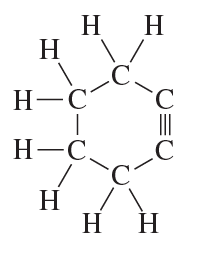
Explain why the following compound is not stable:
Chemical structure of benzyne, showing its unstable arrangement of carbon and hydrogen atoms.

Verified step by step guidance
1
Analyze the structure of the compound: The image shows a six-membered ring with alternating double bonds, resembling benzene but with one of the double bonds missing, making it a non-aromatic compound.
Recall the concept of aromaticity: Aromatic compounds must satisfy Huckel's rule, which states that a molecule must have (4n + 2) π electrons in a conjugated cyclic system to be aromatic and stable.
Count the π electrons in the compound: Each double bond contributes 2 π electrons. In this structure, there are only 4 π electrons, which does not satisfy Huckel's rule (4n + 2). This makes the compound non-aromatic.
Consider the implications of non-aromaticity: Non-aromatic compounds lack the delocalized π electron cloud that provides extra stability to aromatic compounds. This results in reduced stability for the given structure.
Evaluate strain and reactivity: The compound may also experience angle strain due to the sp2 hybridized carbons in the ring, and the lack of aromatic stabilization makes it more reactive and less stable overall.

Verified video answer for a similar problem:

This video solution was recommended by our tutors as helpful for the problem above.
Video duration:
2m
Was this helpful?

Key Concepts

Here are the essential concepts you must grasp in order to answer the question correctly.

Benzyne Structure

Benzyne is a reactive intermediate in organic chemistry characterized by a six-membered aromatic ring with a triple bond between two carbon atoms. This unique structure results from the removal of a hydrogen atom from a benzene ring, leading to a highly strained and unstable configuration due to the presence of a sp-hybridized carbon.
Recommended video:
Guided course
03:20
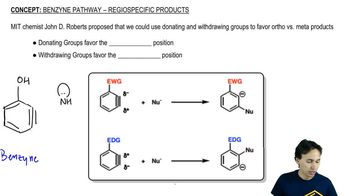
Regiospecificity

Aromatic Stability

Aromatic compounds, like benzene, are known for their stability due to resonance and delocalization of electrons across the ring. However, benzyne's structure disrupts this delocalization, creating localized double bonds that increase strain and reduce stability, making it more reactive than typical aromatic compounds.
Recommended video:
Guided course
08:19
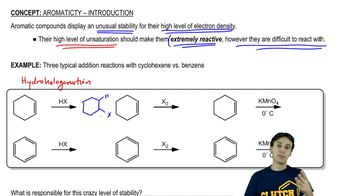
Intro to Aromaticity

Strain and Reactivity

The instability of benzyne can be attributed to angle strain and torsional strain. The presence of the triple bond forces the bond angles to deviate from the ideal 120 degrees of a planar aromatic system, leading to increased reactivity as the compound seeks to relieve this strain through chemical reactions.
Recommended video:
Guided course
02:00
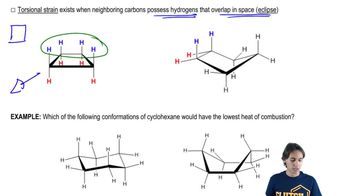
What is torsional strain?