
Textbook Question
Hydrogen gas (H2) has a relatively high pKa value. Is it a stable or unstable acid? Do you expect it to participate in acid–base reactions?
1549
views

 Verified step by step guidance
 2:50
2:50
 04:00
04:00 10:08
10:08Hydrogen gas (H2) has a relatively high pKa value. Is it a stable or unstable acid? Do you expect it to participate in acid–base reactions?
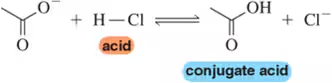
Using qualitative reasoning for the acid–base reactions shown,
(i) which is stronger, the acid or the conjugate acid?
(ii) Which side of the reaction is favored?
(iii) Would you expect a Keq greater than, equal to, or less than 1?
(b)
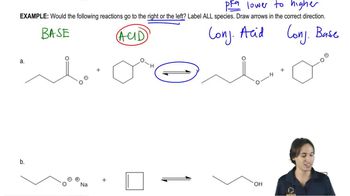
Using qualitative reasoning for the acid–base reactions shown,
(i) which is stronger, the base or the conjugate base?
(ii) Which side of the reaction is favored?
(iii) Would you expect a Keq greater than or less than 1?
(a)
If a base has a conjugate acid with a high pKa value, is it stable or unstable? How do you know this is true (besides 'I just remember')?
Using qualitative reasoning for the acid–base reactions shown,
(i) which is stronger, the base or the conjugate base?
(ii) Which side of the reaction is favored?
(iii) Would you expect a Keq greater than or less than 1?
(c)
How do you know that a proton with a low pKa value is acidic (besides 'I just remember')?