Ch. 20 - The Organic Chemistry of Carbohydrates
Bruice - Organic Chemistry 8th Edition
Bruice8th EditionOrganic ChemistryISBN: 9780135213711Not the one you use?Change textbook
Chapter 21, Problem 11

When D-tagatose is added to a basic aqueous solution, an equilibrium mixture of monosaccharides is obtained, two of which are aldohexoses and two of which are ketohexoses. Identify the aldohexoses and ketohexoses.

Verified step by step guidance
1
Understand the problem: d-Tagatose is a ketohexose, and when it is added to a basic aqueous solution, it undergoes keto-enol tautomerism. This process allows the interconversion between ketohexoses and aldohexoses, leading to an equilibrium mixture of monosaccharides.
Recall the concept of keto-enol tautomerism: In basic conditions, the hydrogen atom on the alpha-carbon (adjacent to the carbonyl group) can be abstracted, forming an enolate ion. This enolate ion can then rearrange to form either a ketone or an aldehyde, depending on the pathway.
Identify the possible aldohexoses: The enolate intermediate formed from d-tagatose can rearrange to form two aldohexoses. These are d-galactose and d-talose, which are stereoisomers differing in the configuration of their hydroxyl groups.
Identify the possible ketohexoses: d-Tagatose itself is one of the ketohexoses in the equilibrium mixture. The other ketohexose is d-fructose, which is formed through the same keto-enol tautomerism process.
Summarize the equilibrium mixture: The equilibrium mixture consists of two aldohexoses (d-galactose and d-talose) and two ketohexoses (d-tagatose and d-fructose). These interconvert through the enolate intermediate under basic conditions.

Verified video answer for a similar problem:

This video solution was recommended by our tutors as helpful for the problem above.
Video duration:
12m
Was this helpful?

Key Concepts

Here are the essential concepts you must grasp in order to answer the question correctly.

Monosaccharides

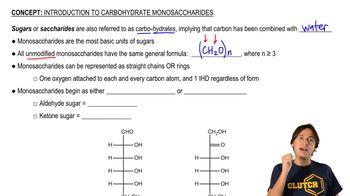
Monosaccharides are the simplest form of carbohydrates, consisting of single sugar units. They can be classified based on the functional group present: aldoses contain an aldehyde group, while ketoses contain a ketone group. Understanding the structure and classification of monosaccharides is essential for identifying the products formed in reactions involving sugars.
Recommended video:
Guided course
12:01
Monosaccharide

Aldohexoses and Ketohexoses

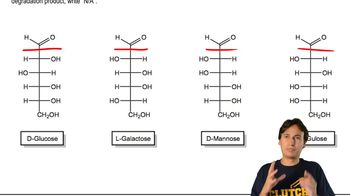
Aldohexoses are six-carbon sugars with an aldehyde group, while ketohexoses are six-carbon sugars with a ketone group. Common examples include glucose and galactose as aldohexoses, and fructose as a ketohexose. Recognizing these specific types of monosaccharides is crucial for determining the products of the reaction involving d-tagatose.
Recommended video:
Guided course
02:29
Which aldohexoses produce the same Wohl Degradation product

Equilibrium in Chemical Reactions

Equilibrium in chemical reactions refers to the state where the rates of the forward and reverse reactions are equal, resulting in constant concentrations of reactants and products. In the context of d-tagatose in a basic aqueous solution, understanding how equilibrium affects the formation of different monosaccharides helps predict the mixture's composition, including the aldohexoses and ketohexoses produced.
Recommended video:
3:11
Chemical Reactions of Phosphate Anhydrides Concept 1