Ch. 21 - Amino Acids, Peptides, and Proteins
Bruice - Organic Chemistry 8th Edition
Bruice8th EditionOrganic ChemistryISBN: 9780135213711Not the one you use?Change textbook
Chapter 22, Problem 75c

Show how valine can be prepared by
c. a reductive amination.

Verified step by step guidance
1
Identify the starting material: To prepare valine via reductive amination, you need to start with the corresponding α-keto acid, which is α-ketoisovaleric acid (3-methyl-2-oxobutanoic acid). This compound has the same carbon skeleton as valine but contains a keto group instead of an amino group.
Understand the reductive amination process: Reductive amination involves the reaction of a carbonyl compound (in this case, the keto group of α-ketoisovaleric acid) with ammonia (NH₃) or a primary/secondary amine, followed by reduction to form the corresponding amine.
React the α-keto acid with ammonia: Add ammonia (NH₃) to the α-ketoisovaleric acid. This step forms an imine intermediate (a compound with a C=N bond) through a condensation reaction where water is eliminated.
Reduce the imine intermediate: Use a reducing agent, such as sodium cyanoborohydride (NaBH₃CN) or hydrogen gas (H₂) with a metal catalyst (e.g., Pd/C), to reduce the imine to a primary amine. This step converts the imine into the amino group, resulting in valine.
Isolate and purify the product: After the reaction is complete, isolate valine by techniques such as crystallization or chromatography, and confirm its structure using spectroscopic methods like NMR or IR.

Verified video answer for a similar problem:

This video solution was recommended by our tutors as helpful for the problem above.
Video duration:
3m
Was this helpful?

Key Concepts

Here are the essential concepts you must grasp in order to answer the question correctly.

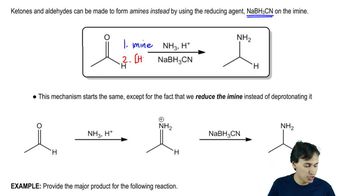
Reductive Amination

Reductive amination is a chemical reaction that involves the conversion of a carbonyl compound, such as an aldehyde or ketone, into an amine. This process typically includes the formation of an imine or enamine intermediate, which is then reduced to yield the corresponding amine. In the case of valine, this reaction can be used to introduce the amino group onto a suitable precursor, such as a keto acid.
Recommended video:
Guided course
07:12
Reductive Amination

Valine Structure and Properties

Valine is an essential branched-chain amino acid with the chemical structure C5H11NO2. It features a side chain that is isopropyl, making it hydrophobic and contributing to its role in protein structure and function. Understanding valine's structure is crucial for recognizing how it can be synthesized through reductive amination, as the correct functional groups must be present in the starting materials.
Recommended video:
1:19
Polymers Structure and Properties Concept 1

Keto Acids in Amino Acid Synthesis

Keto acids are organic compounds that contain a ketone functional group and can serve as precursors in amino acid synthesis. In the context of valine preparation, a keto acid such as alpha-ketovalerate can be used as the starting material. The reductive amination process will involve the reaction of this keto acid with ammonia or an amine, followed by reduction to form valine.
Recommended video:
1:16
Synthesis of Amino Acids: Strecker Synthesis Example 1