Ch. 8 - Delocalized Electrons: Their Effect on Stability, pKa, and the Products of a Reaction • Aromaticity and Electronic Effects: An Introduction to the Reactions of Benzene
Bruice - Organic Chemistry 8th Edition
Bruice8th EditionOrganic ChemistryISBN: 9780135213711Not the one you use?Change textbook
Chapter 9, Problem 73b

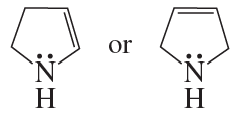
Which compound has the greater electron density on its nitrogen atom?
Two chemical structures with nitrogen atoms, questioning which has greater electron density on nitrogen.

Verified step by step guidance
1
Identify the compounds involved in the problem. If the compounds are not explicitly provided, consider general factors that influence electron density on a nitrogen atom, such as resonance, inductive effects, and hybridization.
Examine the electronic environment around the nitrogen atom in each compound. Look for electron-donating groups (EDGs) or electron-withdrawing groups (EWGs) attached to the nitrogen or nearby atoms. EDGs increase electron density, while EWGs decrease it.
Consider resonance effects. If the nitrogen atom is part of a conjugated system or can participate in resonance, determine whether resonance delocalizes electron density away from or toward the nitrogen atom.
Evaluate the hybridization of the nitrogen atom. A nitrogen atom with sp3 hybridization (e.g., in an amine) generally has higher electron density compared to sp2 or sp hybridized nitrogen atoms (e.g., in an imine or nitrile), as sp3 orbitals hold electrons closer to the nucleus.
Compare the overall electron density on the nitrogen atom in each compound based on the above factors. The compound with more electron-donating effects, less resonance delocalization, and/or sp3 hybridization will have greater electron density on its nitrogen atom.

Verified video answer for a similar problem:

This video solution was recommended by our tutors as helpful for the problem above.
Video duration:
6m
Was this helpful?

Key Concepts

Here are the essential concepts you must grasp in order to answer the question correctly.

Electron Density

Electron density refers to the probability of finding electrons in a particular region around an atom. In organic chemistry, it is crucial for understanding reactivity and bonding. Higher electron density on an atom, such as nitrogen, indicates a greater ability to donate electrons, influencing the compound's nucleophilicity and basicity.
Recommended video:
Guided course
03:54
The 18 and 16 Electron Rule

Electronegativity

Electronegativity is a measure of an atom's ability to attract and hold onto electrons within a chemical bond. In the context of nitrogen, its electronegativity affects the distribution of electron density in a molecule. Compounds with electronegative substituents can withdraw electron density from nitrogen, thereby reducing its overall electron density.
Recommended video:
Guided course
1:47
Electronegativity

Resonance Structures

Resonance structures are different ways of drawing a molecule that represent the same compound, highlighting the delocalization of electrons. In compounds with nitrogen, resonance can stabilize or destabilize the electron density on the nitrogen atom. Understanding resonance is essential for predicting the electron density and reactivity of nitrogen-containing compounds.
Recommended video:
Guided course
03:04
Drawing Resonance Structures