Ch. 13 - Alcohols, Ethers and Related Compounds: Substitution and Elimination
Mullins - Organic Chemistry: A Learner Centered Approach 1st Edition
Mullins1st EditionOrganic Chemistry: A Learner Centered ApproachISBN: 9780137566471Not the one you use?Change textbook
Chapter 12, Problem 86e

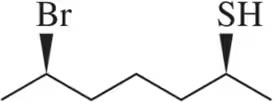
Using IUPAC rules, name the following molecules.
(e) Molecular structure with a bromine (Br) and thiol (SH) group attached to a zigzag carbon chain.

Verified step by step guidance
1
Identify the longest continuous carbon chain in the molecule. This will serve as the parent hydrocarbon, and its length will determine the base name (e.g., methane, ethane, propane, etc.).
Number the carbon atoms in the longest chain starting from the end nearest to the first substituent encountered. This ensures that substituents receive the lowest possible numbers.
Identify and name all substituents attached to the main carbon chain. Common substituents include alkyl groups like methyl (CH₃-), ethyl (C₂H₅-), and halogens like chloro (Cl-), bromo (Br-), etc.
Assign a number to each substituent based on its position on the main chain. If there are multiple identical substituents, use prefixes such as di-, tri-, tetra-, etc., to indicate their quantity.
Combine the elements of the name into a single word: start with the substituents in alphabetical order, followed by the base name of the main chain. Use hyphens to separate numbers from letters and commas to separate multiple numbers.

Verified video answer for a similar problem:

This video solution was recommended by our tutors as helpful for the problem above.
Video duration:
8m
Was this helpful?

Key Concepts

Here are the essential concepts you must grasp in order to answer the question correctly.

IUPAC Nomenclature

IUPAC nomenclature is a standardized system for naming chemical compounds, ensuring consistency and clarity in communication. It involves identifying the longest carbon chain, determining the principal functional group, and assigning locants to substituents. This systematic approach helps in accurately describing the structure of organic molecules.
Recommended video:
Guided course
03:43
The different parts of an IUPAC name

Functional Groups

Functional groups are specific groups of atoms within molecules that are responsible for the characteristic chemical reactions of those molecules. Recognizing functional groups such as alcohols, alkenes, and carboxylic acids is crucial in IUPAC naming, as they determine the suffix and influence the numbering of the carbon chain.
Recommended video:
Guided course
02:36
Identifying Functional Groups

Locants and Substituents

Locants are numbers assigned to the carbon atoms in the longest chain to indicate the position of substituents or functional groups. Substituents are atoms or groups of atoms attached to the main carbon chain. Correctly identifying and numbering these elements is essential for precise IUPAC naming, ensuring the name reflects the molecule's structure.
Recommended video:
Guided course
01:47
Nucleophiles and Electrophiles can react in Substitution Reactions.