

Ch. 12 - Infrared Spectroscopy and Mass Spectrometry
Wade - Organic Chemistry 9th Edition
Wade9th EditionOrganic ChemistryISBN: 9780135213728Not the one you use?Change textbook
Chapter 12, Problem 31

Consider the following four structures, followed by mass spectral data. Match each structure with its characteristic molecular ion or fragment. In each case, give a likely structure of the ion responsible for the base peak.

(a) base peak at 105
(b) base peak at 72
(c) M+ doublet at 198 and 200, base peak at 91
(d) base peak at 91, large peak at 43

Verified step by step guidance
1
Step 1: Analyze the structure labeled I. This is ethylbenzene, which contains a benzene ring attached to an ethyl group. The base peak at 91 corresponds to the tropylium ion (C7H7+), a common fragment formed from alkylbenzenes due to the stability of the tropylium ion.
Step 2: Examine structure II. This is bromobenzene, which contains a benzene ring attached to a bromine atom. The molecular ion doublet at 198 and 200 is characteristic of bromine isotopes (79Br and 81Br). The base peak at 91 again corresponds to the tropylium ion, formed from the benzene ring.
Step 3: Look at structure III. This is acetone, a simple ketone. The base peak at 72 corresponds to the molecular ion fragment resulting from the loss of a methyl group (CH3) from the parent molecule, forming the ion CH3CO+.
Step 4: Analyze structure IV. This is 1-pentene, an alkene. The base peak at 43 corresponds to the fragment CH3CH2+, which is formed from the cleavage of the alkene chain. The large peak at 43 is due to the stability of this alkyl fragment.
Step 5: Match each structure with its corresponding mass spectral data: (a) Structure III (base peak at 105), (b) Structure IV (base peak at 72), (c) Structure II (M+ doublet at 198 and 200, base peak at 91), (d) Structure I (base peak at 91, large peak at 43).

Verified video answer for a similar problem:

This video solution was recommended by our tutors as helpful for the problem above.
Video duration:
6m
Was this helpful?

Key Concepts

Here are the essential concepts you must grasp in order to answer the question correctly.

Mass Spectrometry Basics

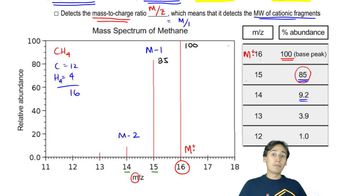
Mass spectrometry is an analytical technique used to measure the mass-to-charge ratio of ions. It involves ionizing chemical species and sorting the ions based on their mass. The resulting mass spectrum provides information about the molecular weight and structure of the compounds, including the molecular ion peak (M+) and fragment ions, which are crucial for identifying the components of a sample.
Recommended video:
Guided course
01:25
How to Read a Mass Spectrum

Base Peak and Molecular Ion

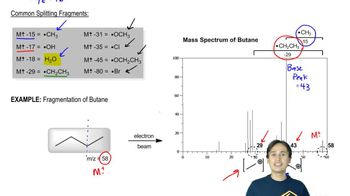
The base peak in a mass spectrum is the most intense peak, representing the most stable ion formed during fragmentation. The molecular ion (M+) corresponds to the intact molecule's mass, while fragment ions result from the breakdown of the molecular ion. Understanding the relationship between these peaks helps in deducing the structure of the original compound and its fragments.
Recommended video:
Guided course
01:27
Clarification on the Base Peak

Fragmentation Patterns

Fragmentation patterns refer to the specific ways in which a molecular ion breaks apart into smaller ions during mass spectrometry. These patterns are influenced by the structure of the molecule, including functional groups and stability of the resulting fragments. Recognizing common fragmentation pathways, such as the loss of small molecules or rearrangements, is essential for predicting the ions responsible for observed peaks in the mass spectrum.
Recommended video:
Guided course
08:06
Common Splitting Patterns