Ch. 2 - Acids and Bases: Central to Understanding Organic Chemistry
Bruice - Organic Chemistry 8th Edition
Bruice8th EditionOrganic ChemistryISBN: 9780135213711Not the one you use?Change textbook
Chapter 3, Problem 38d,e

Using the table of pKa values given in [Appendix I] , answer the following:
d. Which is more electronegative: an sp3 oxygen or an sp2 oxygen?
e. Which compounds demonstrate that the relative electronegativities of a hybridized nitrogen atom are sp > sp2 > sp3?

Verified step by step guidance
1
Step 1: Understand the relationship between electronegativity and hybridization. Electronegativity increases with greater s-character in the hybrid orbitals. For example, sp orbitals have 50% s-character, sp2 orbitals have 33% s-character, and sp3 orbitals have 25% s-character. This means sp > sp2 > sp3 in terms of electronegativity.
Step 2: For part (d), identify compounds in Appendix I with hydrogens attached to sp2 oxygen and sp3 oxygen. For example, an sp2 oxygen is found in a compound like a carboxylic acid (R-COOH), while an sp3 oxygen is found in an alcohol (R-OH). Compare their pKa values. Lower pKa values indicate stronger acids, which correspond to more electronegative atoms stabilizing the conjugate base.
Step 3: Analyze the pKa values of the chosen compounds. For example, the pKa of a carboxylic acid (sp2 oxygen) is typically around 4-5, while the pKa of an alcohol (sp3 oxygen) is around 15-18. The lower pKa of the carboxylic acid suggests that the sp2 oxygen is more electronegative than the sp3 oxygen.
Step 4: For part (e), identify compounds in Appendix I that demonstrate the relative electronegativities of sp, sp2, and sp3 hybridized nitrogen atoms. For example, an sp nitrogen can be found in a terminal alkyne (R-C≡N), an sp2 nitrogen in an imine (R2C=NH), and an sp3 nitrogen in an amine (R-NH2). Compare their pKa values.
Step 5: Compare the pKa values of the compounds with sp, sp2, and sp3 hybridized nitrogen atoms. The compound with the sp nitrogen will have the lowest pKa (strongest acid), followed by the sp2 nitrogen, and then the sp3 nitrogen. This trend reflects the increasing electronegativity of nitrogen as the s-character of its hybrid orbitals increases.

Verified video answer for a similar problem:

This video solution was recommended by our tutors as helpful for the problem above.
Was this helpful?

Key Concepts

Here are the essential concepts you must grasp in order to answer the question correctly.

Hybridization

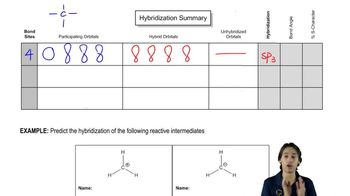
Hybridization is the concept in organic chemistry that describes the mixing of atomic orbitals to form new hybrid orbitals. The type of hybridization (sp, sp2, sp3) affects the geometry and bonding properties of molecules. For example, sp hybridization involves one s and one p orbital, resulting in linear geometry, while sp3 involves one s and three p orbitals, leading to tetrahedral geometry.
Recommended video:
Guided course
10:43
Using bond sites to predict hybridization

Electronegativity

Electronegativity is a measure of an atom's ability to attract and hold onto electrons in a chemical bond. In the context of hybridized atoms, electronegativity can vary based on the hybridization state; sp hybridized atoms are generally more electronegative than sp2, which in turn are more electronegative than sp3. This trend is crucial for understanding the acidity of compounds, as more electronegative atoms stabilize negative charges better.
Recommended video:
Guided course
1:47
Electronegativity

pKa Values

pKa values indicate the strength of an acid in solution, with lower pKa values corresponding to stronger acids. The pKa can provide insight into the stability of the conjugate base formed after deprotonation. By comparing pKa values of compounds with sp2 and sp3 hybridized oxygens, one can infer the relative electronegativities and acidity of the respective functional groups.
Recommended video:
Guided course
07:45
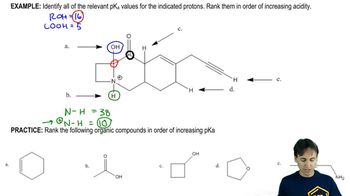
Identifying pKa values
Related Practice
Textbook Question

For each of the following compounds (here shown in their acidic forms), write the form that ­predominates in a solution with a pH = 5.5:

c. H3O+ (pKa = −1.7)

d. HBr (pKa = −9)

532
views

Textbook Question

For each of the following compounds (here shown in their acidic forms), write the form that ­predominates in a solution with a pH = 5.5:

a. CH3COOH(pKa = 4.76)

b. CH3CH2N+H3 (pKa = 11.0)

1530
views
Textbook Question

Fosamax (shown on the previous page) has six acidic groups. The active form of the drug, which has lost two of its acidic protons, is shown in the box. 

(Notice that the phosphorus atom in Fosamax and the sulfur atom in [Problem 36] can be surrounded by more than eight electrons because P and S are below the second row of the periodic table.)

a. Why are the OH groups bonded to phosphorus the strongest acids of the six groups?

b. Which of the remaining four groups is the weakest acid?

1239
views
Textbook Question

For each of the following compounds (here shown in their acidic forms), write the form that ­predominates in a solution with a pH = 5.5:

e. +NH4 (pKa = 9.4)

f. HC≡N (pKa = 9.1)

696
views
Textbook Question

For each of the following compounds, indicate the atom that is protonated when an acid is added to a solution of the compound.

c.

d.

1607
views
1
rank
Textbook Question

Using the table of pKa values given in [Appendix I], answer the following:

a. Which is the most acidic organic compound in the table?

b. Which is the least acidic organic compound in the table?

c. Which is the most acidic carboxylic acid in the table?

1376
views