Ch. 3 - An Introduction to Organic Compounds:Nomenclature, Physical Properties, and Structure
Bruice - Organic Chemistry 8th Edition
Bruice8th EditionOrganic ChemistryISBN: 9780135213711Not the one you use?Change textbook
Chapter 4, Problem 79

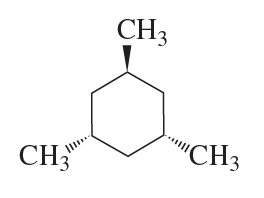
Draw the most stable conformer of the following molecule. (A solid wedge points out of the plane of the paper toward the viewer. A hatched wedge points back from the plane of the paper away from the viewer.)
Molecule diagram showing a cyclohexane with one solid wedge and one hatched wedge indicating 3D orientation of substituents.

Verified step by step guidance
1
Step 1: Identify the molecule as a substituted cyclohexane ring with three methyl groups attached. The solid wedge indicates a substituent pointing out of the plane (axial or equatorial), the hatched wedge indicates a substituent pointing into the plane, and the plain bond is in the plane of the ring.
Step 2: Recall that cyclohexane adopts a chair conformation to minimize steric strain. In the chair conformation, substituents can occupy axial (parallel to the ring's axis) or equatorial (pointing outward from the ring) positions.
Step 3: To determine the most stable conformer, place bulky groups (like methyl groups) in equatorial positions whenever possible. This minimizes steric hindrance and 1,3-diaxial interactions.
Step 4: Analyze the given structure. The methyl group on the solid wedge is pointing out of the plane, which corresponds to an equatorial position in one chair conformation. The methyl group on the hatched wedge is pointing into the plane, which corresponds to an axial position in the same chair conformation.
Step 5: Draw the chair conformation with the methyl groups placed in their respective positions (equatorial or axial) based on the given wedges. Ensure that the largest substituents occupy equatorial positions to achieve the most stable conformer.

Verified video answer for a similar problem:

This video solution was recommended by our tutors as helpful for the problem above.
Video duration:
5m
Was this helpful?

Key Concepts

Here are the essential concepts you must grasp in order to answer the question correctly.

Conformational Analysis

Conformational analysis involves studying the different spatial arrangements of a molecule that can be achieved by rotation around single bonds. In cyclic compounds, such as cyclohexane derivatives, various conformers can exist, each with different stability due to steric interactions and torsional strain. Understanding these conformers is crucial for predicting the most stable structure of a molecule.
Recommended video:
Guided course
03:29
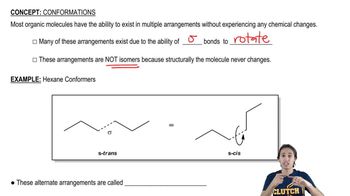
Understanding what a conformer is.

Steric Hindrance

Steric hindrance refers to the repulsion between bulky groups within a molecule that can affect its stability and reactivity. In conformers, bulky substituents prefer to be positioned in a way that minimizes interactions with other groups, often leading to staggered arrangements. Recognizing steric hindrance is essential for determining the most stable conformer of a molecule.
Recommended video:
Guided course
02:53
Understanding steric effects.

Wedge and Dash Notation

Wedge and dash notation is a method used to represent three-dimensional structures of molecules on a two-dimensional plane. Solid wedges indicate bonds that project out of the plane towards the viewer, while hatched wedges represent bonds that extend back away from the viewer. This notation is vital for visualizing the spatial orientation of substituents in conformers, aiding in the identification of the most stable arrangement.
Recommended video:
Guided course
06:20
Alternative MO Notation for Dienes