Ch. 20 - Carboxylic Acids
Wade - Organic Chemistry 9th Edition
Wade9th EditionOrganic ChemistryISBN: 9780135213728Not the one you use?Change textbook
Chapter 20, Problem 34a,b

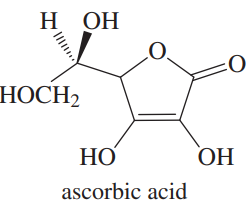
Given the structure of ascorbic acid (vitamin C):
Chemical structure of ascorbic acid (vitamin C) with labeled functional groups and molecular formula.
(a) Is ascorbic acid a carboxylic acid?
(b) Compare the acid strength of ascorbic acid (pKa = 4.71) with acetic acid.

Verified step by step guidance
1
Examine the structure of ascorbic acid provided in the image. Notice the presence of hydroxyl groups (-OH) and a lactone ring, which is a cyclic ester. This structure does not contain a carboxylic acid group (-COOH), which is characterized by a carbonyl group (C=O) directly bonded to a hydroxyl group (OH). Therefore, ascorbic acid is not a carboxylic acid.
Understand the concept of acid strength, which is often expressed in terms of pKa values. The pKa value is the negative logarithm of the acid dissociation constant (Ka), and it indicates the tendency of an acid to donate a proton. Lower pKa values correspond to stronger acids.
Compare the pKa value of ascorbic acid (4.71) with that of acetic acid, which is approximately 4.76. Since ascorbic acid has a slightly lower pKa value than acetic acid, it is a slightly stronger acid.
Consider the structural factors that might influence the acidity of ascorbic acid. The presence of electron-withdrawing groups or resonance stabilization can enhance acidity by stabilizing the conjugate base formed after proton donation.
Reflect on the implications of acid strength in biological systems. Ascorbic acid's ability to donate protons can play a role in its function as an antioxidant, where it can neutralize free radicals by donating electrons or hydrogen atoms.

Verified video answer for a similar problem:

This video solution was recommended by our tutors as helpful for the problem above.
Video duration:
1m
Was this helpful?

Key Concepts

Here are the essential concepts you must grasp in order to answer the question correctly.

Carboxylic Acid Functional Group

A carboxylic acid contains a functional group characterized by a carbonyl (C=O) and a hydroxyl (OH) group attached to the same carbon atom, forming a -COOH group. In the structure of ascorbic acid, this specific arrangement is absent, indicating it is not a carboxylic acid despite having acidic properties.
Recommended video:
Guided course
02:36
Identifying Functional Groups

Acid Strength and pKa

Acid strength is often measured by the pKa value, which indicates the tendency of an acid to donate a proton. A lower pKa value signifies a stronger acid. Ascorbic acid has a pKa of 4.71, which is lower than acetic acid's pKa of 4.76, suggesting ascorbic acid is slightly stronger as an acid.
Recommended video:
Guided course
07:45
Identifying pKa values

Functional Groups in Ascorbic Acid

Ascorbic acid contains several functional groups, including hydroxyl groups and an enol form, which contribute to its acidic nature. The presence of these groups, particularly the enol, allows for proton donation, influencing its acidity and differentiating it from typical carboxylic acids.
Recommended video:
Guided course
02:36
Identifying Functional Groups