Ch. 2 - Acids and Bases; Functional Groups
Wade - Organic Chemistry 9th Edition
Wade9th EditionOrganic ChemistryISBN: 9780135213728Not the one you use?Change textbook
Chapter 2, Problem 35e,f

Predict which compound in each pair has the higher boiling point. Explain your prediction.
(e)
(f)

Verified step by step guidance
1
Step 1: Identify the functional groups present in each compound. In pair (e), the first compound is 3-methylpiperidine, which is a secondary amine, and the second compound is 1,3-dimethylpyrrolidine, which is a tertiary amine. In pair (f), the first compound is 2,4-dimethylpyrrolidine, a secondary amine, and the second compound is 4-methylpyrrolidin-2-one, a lactam (cyclic amide).
Step 2: Consider the effect of hydrogen bonding on boiling points. Secondary amines can form hydrogen bonds due to the presence of an N-H bond, whereas tertiary amines cannot form hydrogen bonds as effectively because they lack an N-H bond. Amides, like the lactam in pair (f), can form strong hydrogen bonds due to the presence of both N-H and C=O groups.
Step 3: Analyze the molecular size and shape. Larger and more complex molecules generally have higher boiling points due to increased van der Waals forces. In pair (e), 3-methylpiperidine has a larger ring size compared to 1,3-dimethylpyrrolidine, which may contribute to a higher boiling point.
Step 4: Evaluate the presence of polar groups. The presence of polar groups like the carbonyl group in 4-methylpyrrolidin-2-one (pair f) can increase boiling points due to dipole-dipole interactions.
Step 5: Predict the boiling points based on the above factors. For pair (e), 3-methylpiperidine is likely to have a higher boiling point due to its ability to form hydrogen bonds and larger size. For pair (f), 4-methylpyrrolidin-2-one is expected to have a higher boiling point due to strong hydrogen bonding and dipole-dipole interactions from the carbonyl group.

Verified video answer for a similar problem:

This video solution was recommended by our tutors as helpful for the problem above.
Video duration:
3m
Was this helpful?

Key Concepts

Here are the essential concepts you must grasp in order to answer the question correctly.

Boiling Point and Intermolecular Forces

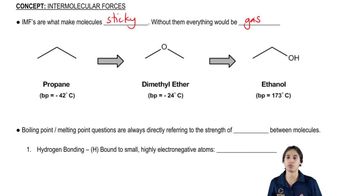
The boiling point of a compound is influenced by the strength of its intermolecular forces. Compounds with stronger forces, such as hydrogen bonding or dipole-dipole interactions, typically have higher boiling points. In organic compounds, the presence of functional groups that can engage in hydrogen bonding significantly raises the boiling point compared to those that cannot.
Recommended video:
Guided course
03:08
How IMFs are related to melting and boiling points.

Hydrogen Bonding

Hydrogen bonding occurs when a hydrogen atom covalently bonded to a highly electronegative atom, like nitrogen, interacts with another electronegative atom. In the context of the compounds presented, the cyclic amine with an NH group can form hydrogen bonds, which enhances its boiling point compared to the compound with a methyl group attached to nitrogen, which cannot form such strong interactions.
Recommended video:
Guided course
00:48
The definition of hydrogenation.

Structural Effects on Boiling Point

The structure of a molecule, including its shape and the presence of substituents, affects its boiling point. For example, cyclic structures may have different steric effects compared to acyclic ones. In the given compounds, the presence of a nitrogen atom in a cyclic structure versus a nitrogen atom with a methyl group can lead to differences in boiling point due to variations in molecular interactions and steric hindrance.
Recommended video:
Guided course
03:08
How IMFs are related to melting and boiling points.
Related Practice
Textbook Question

Rank the following species in order of increasing acidity. Explain your reasons for ordering them as you do.

HF NH3 H2SO4 CH3OH CH3COOH H3O+ H2O

2411
views

Textbook Question

All of the following compounds can react as acids. Without using a table of acidities, rank them in order of increasing acidity. Explain your ranking.

a. CH3CH2SO3H

b. CH3CH2OH

c. CH3CH2COOH

d. CH3CHClCOOH

e. ClCH2CH2COOH

1659
views
2
rank
Textbook Question

N-Methylpyrrolidine has a boiling point of 81 °C, and piperidine has a boiling point of 106 °C.

c. N,N-Dimethylformamide has a boiling point of 150 °C, and N-methylacetamide has a boiling point of 206 °C, for a difference of 56 °C. Explain why these two nitrogen-containing isomers have a much larger boiling point difference than the two amine isomers. Also explain why these two amides have higher boiling points than any of the other four compounds shown (two amines, an ether, and an alcohol).

952
views
Textbook Question

Predict which compound in each pair has the higher boiling point. Explain your prediction.

(a) CH3CH2OCH3 or CH3CH(OH)CH3

(b) CH3CH2CH2CH3 or CH3CH2CH2CH2CH3

3426
views
Textbook Question

Rank the following species in order of increasing basicity. Explain your reasons for ordering them as you do.

NH3 CH3O H2O CH3COO NaOH NH2 HSO4

2106
views
Textbook Question

Predict which compound in each pair has the higher boiling point. Explain your prediction.

(c) CH3CH2CH2CH2CH3 or (CH3)2CH2CH2CH3

(d) CH3CH2CH2CH2CH3 or CH3CH2CH2CH2CH2Cl

3181
views
1
rank